
Women's Health Industry Update October 2026
Women's Health Gets Its Own Shelf
A category that lived in three different aisles is becoming a destination, and strategic acquirers have moved with it. Disclosed women's health deals have cleared a median 1.9x revenue, more than double what the manufacturers of the category's staple products command.

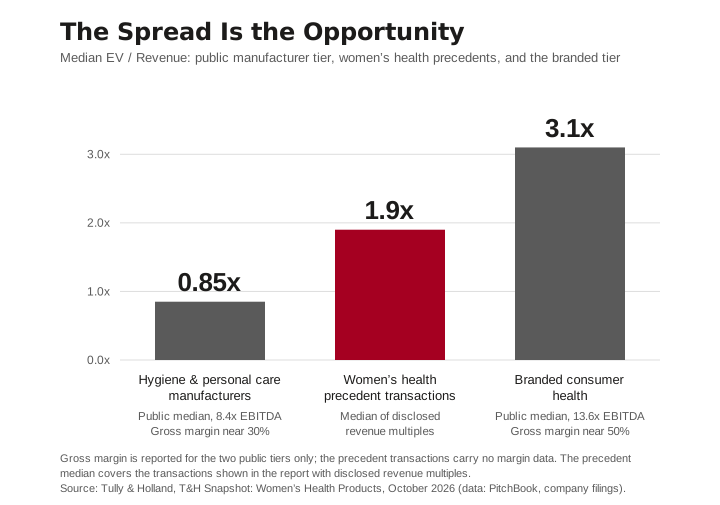
the median multiple on disclosed women's health precedents, against 0.85x for the public hygiene and personal care manufacturers who make the category's staple products.
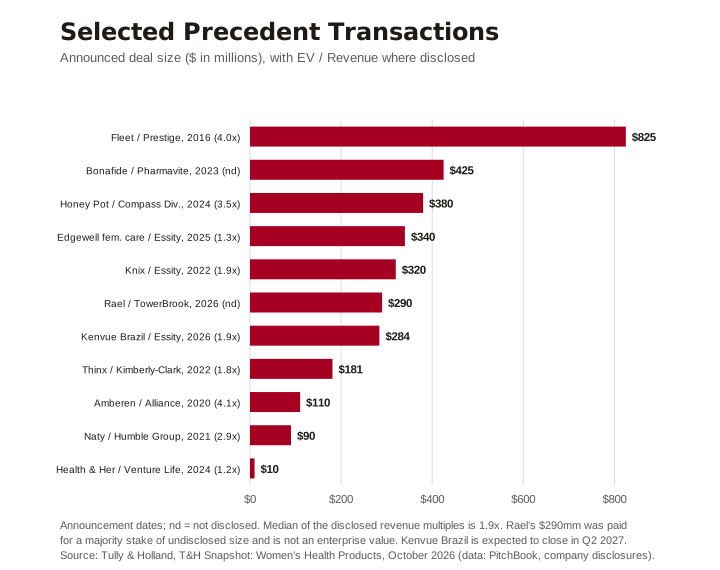
three of the seven largest selected transactions announced since January 2022 came in the last twelve months. The deals are getting bigger and closer together.
the number of US women reaching menopause annually, at a median age of 51. Only 5% of women aged 45 to 64 were treated for symptoms in 2021.
Rael's distribution across Target, Walmart, CVS, Walgreens, and Ulta before TowerBrook agreed to acquire a majority stake. Velocity at scale is what got bought.
Essity's run of feminine care deals, making it the category's most active consolidator. Platform buyers are assembling now.
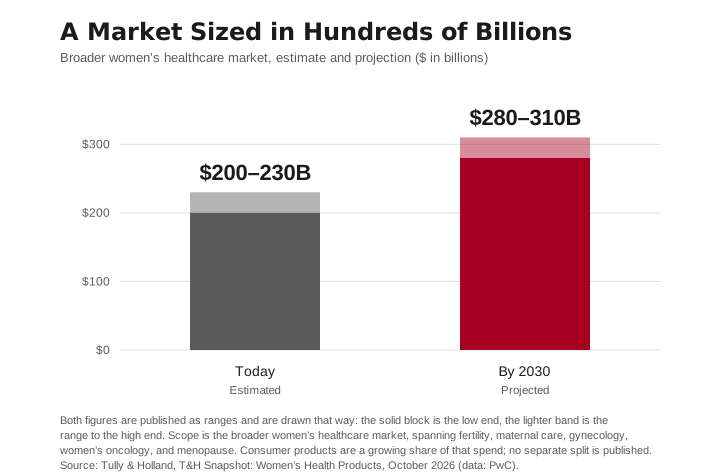
PwC's estimate and projection for the broader women's healthcare market, with consumer products a growing share of that spend.
Executive Summary
Tully & Holland’s Value Proposition: Tully & Holland advises consumer and healthcare product companies, and women’s health sits squarely at the intersection of those sectors.
Women’s health, until very recently scattered across feminine care, vitamin, and skincare aisles in retail, is becoming its own destination in stores, with the likes of Walmart, Walgreens, and Ulta building out dedicated sets for menopause, hormonal, vaginal, and intimate wellness, to better centralize and organize solutions. Strategic acquirers have taken notice of both this merchandising evolution and heightened consumer engagement with the category. Deals are becoming more substantial: three of the seven largest selected transactions announced since January 2022 (see Selected Precedent Transactions, page 3) came in the last twelve months.
PwC estimates the broader women’s healthcare market, spanning fertility, maternal care, gynecology, women’s oncology, and menopause, at roughly $200–230 billion today and projects $280–310 billion by 2030; consumer products are a growing share of that spend. Approximately 1.3 million US women reach menopause each year, at a median age of 51. NORC (formerly the National Opinion Research Center) at the University of Chicago and the AARP Public Policy Institute, analyzing federal survey data, found that only 5% of US women aged 45 to 64, and only 20% to 25% of those experiencing symptoms, were treated for menopause symptoms in 2021. Women are increasingly turning to over-the-counter solutions for their symptoms.
National retailers have each committed expanded shelf space to women’s health over the past eighteen months. Walmart expanded its women’s intimate health assortment to more than 1,000 stores in April 2025; 74% of Walmart’s shoppers are women, and 68% of all its shoppers fall in the Gen X and Boomer cohorts. CVS expanded distribution of O Positiv products to more than 2,100 locations, the brand’s third national chain in under two years, and Walgreens has committed to a dedicated menopause marketing campaign. Ulta Beauty piloted a Wellness by Ulta concept that consolidates skincare, body, sexual wellness, and supplements into one section of its stores.
For sellers, the market is favorable: retailers are devoting more shelf space to the category, and buyers have publicly committed to building in women’s health.
Valuation
Public hygiene and personal care manufacturers trade at a median 0.85x revenue and 8.4x EBITDA on gross margins near 30%; branded consumer health companies trade at 3.1x and 13.6x on margins near 50%. Disclosed women’s health precedents sit between the two at a median 1.9x revenue, well above the manufacturers of the category’s staple products.
The spread between the two public tiers is the point for owners. Scale manufacturers of pads, tampons, and liners are valued on volume and cost, while branded portfolios that own the consumer relationship, carry gross margins near or above 50%, and back their claims with clinical evidence trade at three to four times the manufacturers’ revenue multiple. Buyers of women’s health brands have paid a significant premium to the manufacturer tier, and that spread is what retail velocity, substantiation, and margin discipline protect in a sale process.
Conclusion & Timing
We see three takeaways from the deal flow and current market environment:
- Consumer belief and loyalty drive valuation. Brands that earn consumer trust convert it into strong sales and repeat purchase. Rael had built that following across more than 40,000 doors, including Target, Walmart, CVS, Walgreens, and Ulta, before TowerBrook agreed to acquire a majority stake.
- Product substantiation and gross margin are key valuation drivers. Brands drawing strategic interest lead with clinical or professional validation. In a category carrying FTC and FDA claims exposure, a claims file that survives diligence is critical to valuation.
- Platform buyers are consolidating the shelf. Essity has made four feminine care acquisitions since 2022, and sponsor-backed holding companies in sexual wellness are buying brands to fill owned manufacturing and mass-channel distribution.
Valuations can be particularly attractive while strategics and sponsor-backed platforms are actively building their category positions; as those platforms fill out, the field of motivated buyers is likely to narrow. For owners intending to transact in this cycle, preparation should begin now: retail velocity data by door, a claims file that will survive FTC and FDA review, and a credible path to gross margin expansion are what buyers will ask for first.
At Tully & Holland, we believe women’s health presents meaningful opportunities at the intersection of consumer products and healthcare, particularly for brands that combine clinical substantiation, retail velocity, and repeat purchase.
Text reproduced from the report as published by Tully & Holland.
Keep reading

Convergence of Wellness and Consumer Products
In the 18 months after the pandemic began, consumer transactions with a wellness component totaled more than $77 billion...
Read →
Vitamins & Supplements Update Fall 2022
Nearly 1,800 U.S. supplement manufacturers compete in a market where the top four players hold less than 15% of revenue....
Read →
Consumer Industry Update Q2 2023
Global deal value fell hard in Q2 2023, yet the number of deals getting done rose almost everywhere, and consumer volume...
Read →