
Convergence of Wellness and Consumer Products
When Wellness Became a Multiple
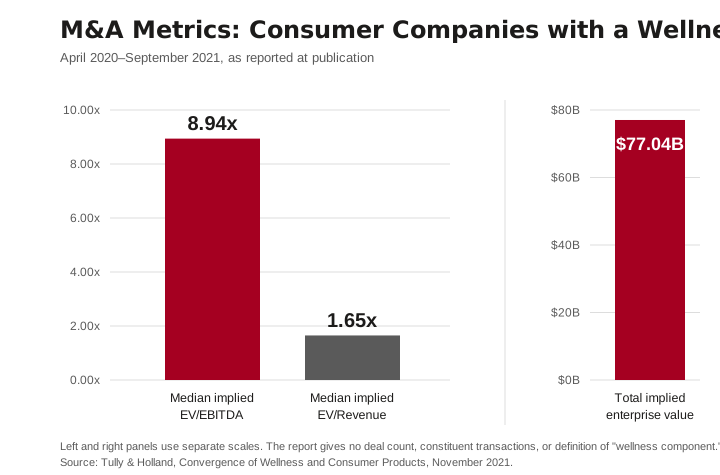
In the 18 months after the pandemic began, consumer transactions with a wellness component totaled more than $77 billion at a median 8.94x EV/EBITDA. Published November 2021, this is our answer to the question the report asked: trend or fad.

total implied enterprise value of consumer transactions with a wellness component between April 2020 and September 2021, as measured in the report.
the median implied EV/EBITDA across that set. The median implied EV/Revenue was 1.65x.
Nestlé's acquisition of The Bountiful Company, the largest single deal named in the report and the clearest marker of what a supplements platform was worth at the time.
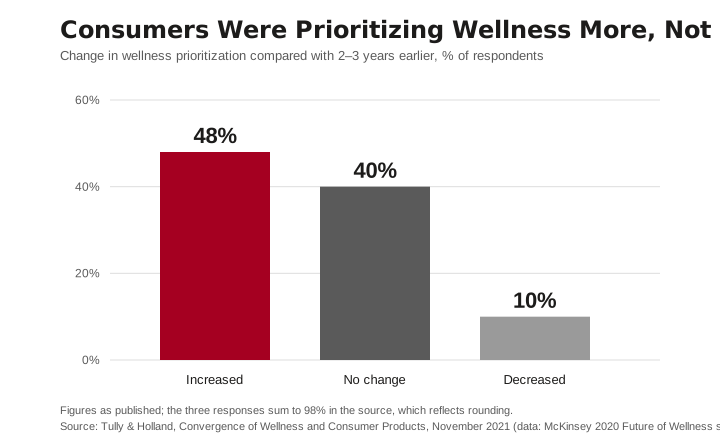
the share of survey respondents who said their wellness prioritization had increased versus two to three years earlier. Only 10% said it had decreased.
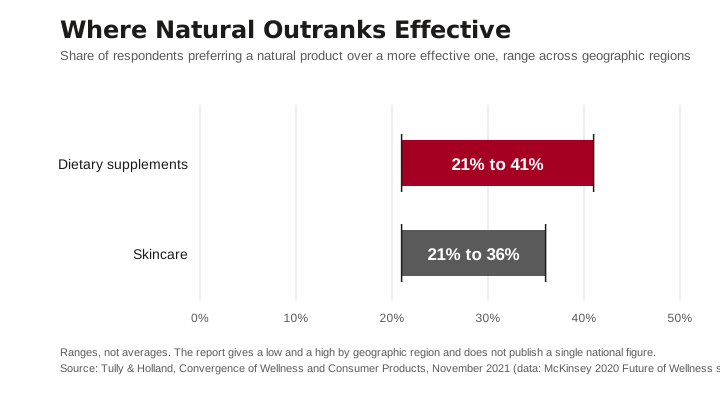
the share of respondents in dietary supplements who said they would choose a natural product over a more effective one, depending on region. Skincare ran 21% to 36%.
the enterprise value range of our own client work, where we saw the same wellness dynamics that drove the headline transactions.
The idea of wellness is nothing new. That said, the permeation of wellness into the broader consumer space is becoming more prominent and accelerated, in large part due to the COVID-19 pandemic. McKinsey’s 2020 Future of Wellness survey findings posit that consumers now view wellness across six dimensions: health, fitness, nutrition, appearance, sleep, and mindfulness. These dimensions span a variety of consumer industries and consumer behaviors, ranging from fresh produce and gyms to the more novel industries of sleep technology and supplements.
Tully & Holland has observed an increasingly strong bias within M&A to companies that can display some direct link to wellness plays. Perhaps even more striking is how wellness is now pushing what were previously distinct industries, such as technology and health care, squarely into everything from supply chain transparency in food production to the improvement and tracking of sleep through smart tech in everyday home products.
TREND OR FAD?
While the durability of some of these trends is unclear, many appear as though they are here to stay. According to the same McKinsey report, nearly half of U.S. consumers have increased their wellness prioritization compared to 2-3 years ago1. These trends can be seen most clearly in dietary supplements and skincare, where 21-41% and 21-36% of respondents, respectively, said that they would prefer a natural product over a more effective one, depending on geographic region. Indeed, we have seen a direct lift in multiples paid in M&A transactions for companies that have 100% organic products, and large resonance for stories that involve a marriage of natural and fairly sourced goods with natural and better for you outcomes.
Key Takeaways & Market Activity
Wellness in the consumer products and services industries takes many forms. Whether it be a desire to eat local, sustainable, or organic, purchase fair-trade products, or improve physical and mental health, companies would be wise to explore strategies and capitalize on these trends.
Merger & Acquisition activity in the consumer sector has certainly benefited from the pandemic and its consequential acceleration of the wellness trend. Larger companies have taken to acquiring smaller, more wellness-minded entities to seize market share and scale successful businesses. Leading the way along such lines was Nestle’s (NSRGY) acquisition of nutritional supplements manufacturer The Bountiful Company for a mammoth $5.75B. But such deals are not reserved for traditional consumer conglomerates. Fitness wearables, interactive exercise devices, vitamin and supplement manufacturers, and health food companies are being bought up by the likes of Alphabet (GOOGL), Lululemon Athletica (LULU), Bayer (BAYN), and a host of private equity firms and SPACs. The total transaction value of consumer companies with a wellness component topped $77B in the 18 months following the beginning of the pandemic, with median EV/EBITDA and EV/Revenue multiples of 8.94x and 1.65x, respectively. This highlights both strategic and financial acquirers’ confidence in the durability and importance of the convergence of wellness and the consumer sector.
While these public acquisition examples are headline worthy, their size is by no means a defining factor for companies that touch upon this theme. At Tully & Holland we work with companies that range in Enterprise Value from $10M-$200M, and the trends described above are prevalent throughout our work. Indeed, just in the past 18 months, companies we have represented touch every aspect of wellness trends. Examples include a specialty and wholly organic coffee company, a contract manufacturer of vitamins and supplements, a non- alcoholic craft beer startup, a food distribution company with a farm to table fresh pro produce arm, a sleep technology company, and another specialty coffee company with direct and transparent sourcing relationships with third-world farmers.
While perhaps early, we believe that the theme of Wellness within consumer products will be the driving focus of both demand and innovation in the sector for years to come; and will be as necessary for competitive positioning as the theme of Sustainability over the past decade. We would welcome the opportunity to discuss your potential interest in any of our current engagements or explore options for future transactions.
Text reproduced from the report as published by Tully & Holland. Photograph: Shixart1985, CC BY 2.0, via Wikimedia Commons.
Keep reading

Advancing with Omnichannel
Published in June 2022, this Topics & Trends piece captured the moment a pandemic survival tactic turned into a permanen...
Read →
Consumer Industry Update Q1 2025
Consumer M&A opened 2025 at an estimated $162 billion in global value, food and beverage deal counts jumped 24.1%, and P...
Read →
Consumer Industry Update Q4 2023
Global M&A rose 13% year-over-year in Q4 2023, consumer deal counts jumped 19% from the prior quarter, and quality consu...
Read →