
Advancing with Omnichannel
Omnichannel Stopped Being Optional
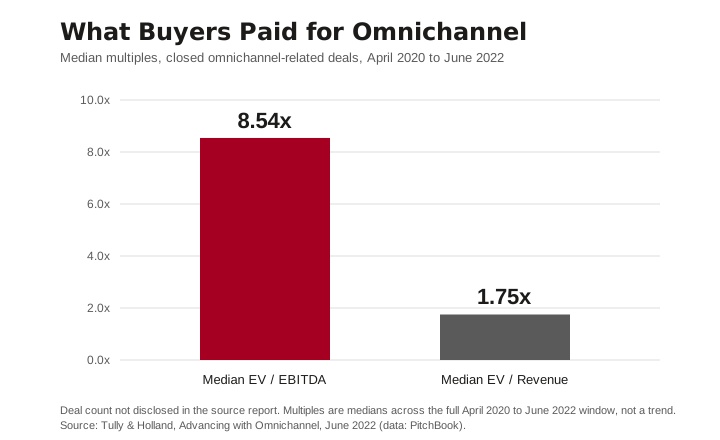
Published in June 2022, this Topics & Trends piece captured the moment a pandemic survival tactic turned into a permanent buyer requirement. Buyers paid a median 8.54x EBITDA for companies that already had the capability.

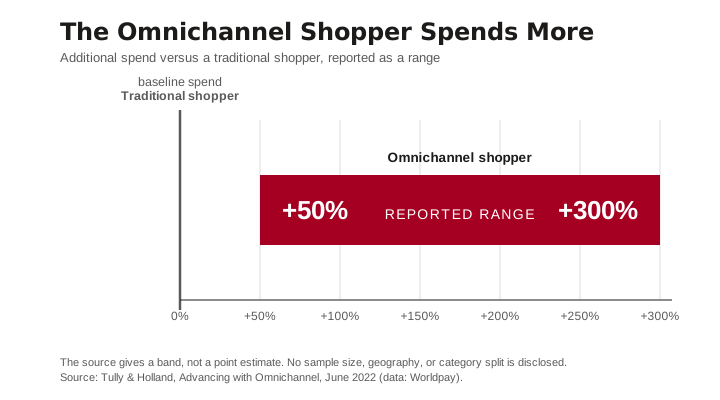
how much more an omnichannel shopper spends than a traditional shopper, per Worldpay research cited in the report. The range is wide, and every point of it argues the same thing.
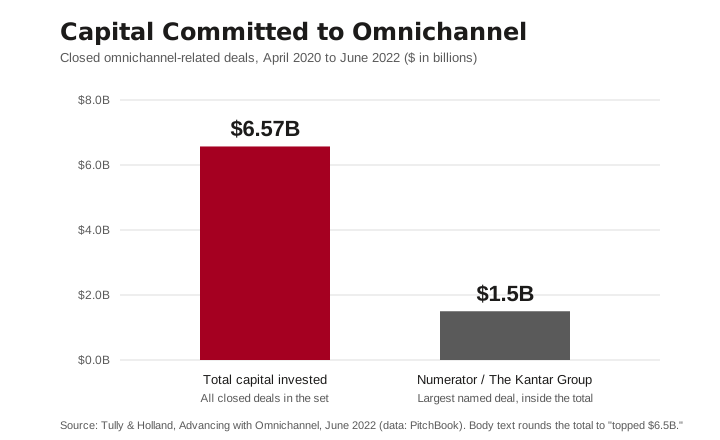
total capital invested in closed omnichannel-related deals in the two years after the pandemic began, April 2020 through June 2022.
the median EV/EBITDA multiple across those transactions, against a median EV/Revenue of 1.75x.
The Kantar Group's acquisition of market-intelligence provider Numerator, the largest deal named in the report.
the Enterprise Value range where Tully & Holland works, and where the same patterns showed up. This was never only a megadeal story.
Porch, Fiserv, Target, and private equity firms were acquiring digital marketing, data analytics, e-commerce, logistics, and customer-engagement businesses outright.
The import of Omnichannel strategies was already well underway, but the COVID pandemic has proven it to be a necessity going forward for retailers to scale, solidify the loyalty of customers, and to ensure sustainable growth.
The Covid-19 pandemic forced many consumer businesses to pivot to omnichannel approaches just to survive. While this “fight or flight” adjustment was reactionary for many it has now proven to be mandatory for almost all. More specific, what began as orientations to safety and flexibility, have now accelerated to consumer expectations and demands for quicker, more efficient, more transparent, and varied ways of obtaining goods and services. Whether its DTC, BTB, partnered delivery, curbside pickup, marketing shifts, inventory management, etc., the omnichannel revolution has now imbedded itself into the supply and demand equation of the consumer experience.
Tully & Holland has seen companies that have embraced this paradigm rewarded within M&A. Indeed, a recent McKinsey report highlights the import omnichannel sales have brought to many not only in top line sales but improved EBITDA margins as well. As we revert back to the “new normal” those with omnichannel presence will be able to pivot most rapidly to accommodate ever evolving consumer demand.
Defining Omnichannel
At its core, the omnichannel evolution is all about bringing the customer experience into the central hub of every touchpoint. From marketing, to shopping, to purchase, to payment, to delivery, etc. -- the customer’s perspective, experience, and efficiency is paramount. The resulting network effect is a company able to better understand, target, serve (and ultimately profit from) a more loyal customer base.
Omnichannel Prevalence
Omnichannel strategies within consumer products and services industries focus on providing enhanced customer experiences and can take many forms. Tactics such as enhancing DTC experiences, marketing through various search engines and unique mediums, integrating new POS platforms, utilizing extended realities (XR) - like (AI) or (VR) - and offering more personalized interactions and delivery capabilities are key. Companies not already doing so would be wise to explore such approaches and capitalize on these trends.
Omnichannel is more than just a trend to watch for and is already core to growth metrics and tangible results. According to Worldpay research, omnichannel shoppers spend between 50-300% more than traditional shoppers. Consequently, companies specifically platformed to enhance customer engagement have helped catalyze M&A activity in the consumer sector. Strategic and financial buyers alike have taken to acquiring these omnichannel-focused entities to seize market share, enhance their own customer engagement capabilities, and generate large returns. Of note was The Kantar Group’s acquisition of market intelligence service provider Numerator for $1.5B. Similarly, digital marketing, AI-based data analytics, e-commerce, retail logistics, and customer engagement companies are attracting buyers like Porch (PRCH), Fiserv (FISV), Target (TGT), and numerous private equity firms. The total M&A value of such examples topped $6.5B in the two years following the beginning of the pandemic, with median EV/EBITDA and EV/Revenue multiples of 8.54x and 1.75x, respectively. This highlights both strategic and financial acquirers’ confidence in the importance of omnichannel in relation to dynamic consumer trends.
While some of these acquisition examples may seem extraordinary, omnichannel is more than just database driven and has been widely adopted throughout the lower middle market. At Tully & Holland we work with companies that range in Enterprise Value from $10M-$200M, and the patterns described are prevalent throughout our work. In the past two years, companies we represented found value from taking a holistic approach to the customer experience. Whether through themes of ethical sourcing, sustainable sourcing, wellness, increased transparency, just in time delivery, private label cost savings, etc., our clients have demonstrated not only an ability to tap into what is core to mindshare, but similarly core to wallet share. The omnichannel revolution is now ensuring that customers, the consumer broadly, is fully aware of these thematic shifts as well.
Tully & Holland believes that the overall ability to compete for continued customer engagement and loyalty will rely largely on omnichannel strategies. To that end, we think consumer companies who are looking for ways to invest in future growth will benefit through adaptation of applicable approaches that will impact both the top and bottom lines. We would welcome the opportunity to discuss your potential interest in any of our current engagements or explore options for future transactions.
Text reproduced from the report as published by Tully & Holland. Photograph: U.S. Department of Agriculture, Public domain, via Wikimedia Commons.
Keep reading

Convergence of Wellness and Consumer Products
In the 18 months after the pandemic began, consumer transactions with a wellness component totaled more than $77 billion...
Read →
Reset vs. Retrenchment
Published in December 2021, as inflation hit a 31-year high and equity markets sat at roughly 2.3 times their long-run e...
Read →
Consumer Industry Update Q1 2025
Consumer M&A opened 2025 at an estimated $162 billion in global value, food and beverage deal counts jumped 24.1%, and P...
Read →