
Reset vs. Retrenchment
When the Consumer Runs Out of "Yeah, But"
Published in December 2021, as inflation hit a 31-year high and equity markets sat at roughly 2.3 times their long-run earnings multiple. Our read at the time on whether the expected consumer reset would turn into a retrenchment, and why we still liked the lower middle market.

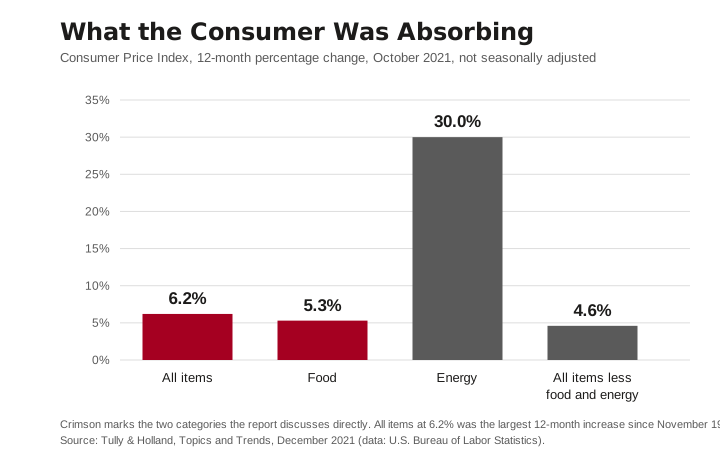
the 12-month rise in the CPI "All items" index through October 2021, the largest increase since November 1990.
the 12-month rise in food prices, the category where much of our work sits, and a direct hit to margins across our client base.
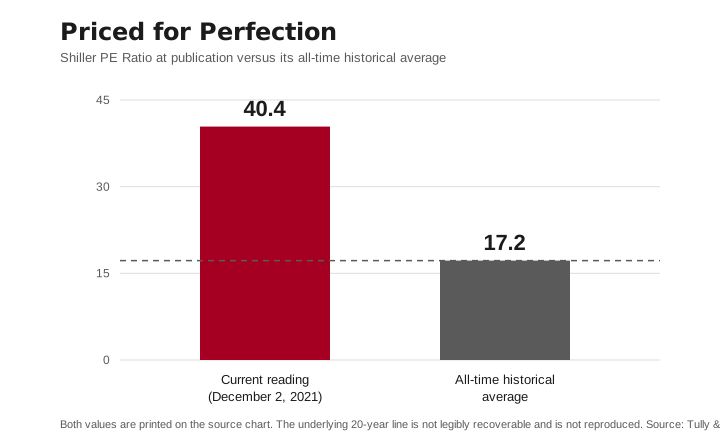
the Shiller PE at the start of December 2021 against its all-time historical average, a market with no room for disappointment priced into it.
our view then was that consumers were absorbing price at the same moment sellers and suppliers were losing ground on profitability, and that demand was the most likely place for the strain to show.
how long we expected supply chains would take to right themselves in full, with normalized inflation perhaps 18 months out from publication.
the enterprise value range of the companies we work with, and the part of the market we argued was better positioned than the headlines suggested.
A year ago, as we prepared to enter 2021, uncertainty around COVID-19 remained but it seemed more a question of when, not if, the societal reset button would be pressed. Vaccines were arriving, kids were increasingly back to school in some form, retail establishments were expected to be “back to normal” by end of Q2, and corporations were debating if they should mandate full workforce returns by July 4th or Labor Day. Throughout it all, the consumer drove a demand-based economy that kept us all both afloat and excited about a soft-landing return to normalcy.
Now, twelve months later, while progress has been made on many fronts, uncertainty around COVID-19 variants exacerbate the broader economic turbulence we face in supply chain backlogs, labor force imbalances, and inflationary pressures across all metrics. Indeed, the question we now must face is whether the very consumer demand that buoyed us will reverse to become an anchor? Only time will tell, but certain topics and trends warrant focus.
Q4 EARNINGS WILL SET THE TONE
Markets are jittery as we begin the final month of 2021, and while some sectors may prove resilient, the Consumer and Retail Sector is not likely to be as profitable. More to the point, while it can often lift corporate results to see shelves depleting over the holidays, the fact that sellers are having to wait longer, and pay more, to slowly re-stock their shelves with ghostly manpower, does not bode well. Pressure on COGS, SG&A, Inventory, and Working Capital metrics will all work against bottom line results. And while some inflation will be passed on in the form of price, the magnitude and lag effect of the gap may be larger than many imagine. Q4 earnings will provide a first look at how well companies are balancing the tightrope walk.
“Yeah, but…” is likely to lose psychological sway
The “Yeah but…” rationalization of the consumer has likely reached a tipping point. Rising inflation, an idling to reversing housing market, turbulent equity markets, and a more hawkish FED make it much harder for Mr. and Ms. Mainstreet to justify discretionary purchases through the cocktail talk of “Yeah, but my 401(k) is up a ton!”; “Yeah, but the equity in my house is a safety net!” “Yeah, but my used car is worth more than it was new!”
Looking to the most recent Consumer Price Index data (see chart above) the “All items” index rose 6.2% for the 12 months ending October. This represents the largest 12 month increase since November 1990. The subcategory of Food, where we at T&H do a lot of work, was up 5.3%. And as much as one would like to believe a righting of the supply chain will normalize prices, it’s never that simple.
First, the righting of the supply chain is not an overnight matter and likely will not occur in full until at least 2023, and that assumes some help on the COVID front. Second, the need to incentivize labor through increased wages will not slow in the near term, likely exacerbating CPI in the next two quarters. Third, no retailer is going to “take back” the price increases once passed on; the best we are all hoping for is a return to normalized rates of inflation in 18 months or so.
Agree or disagree with the timeline, resilience of markets, whether we go into recession, etc. - What is undeniable is the consumer is feeling the hit at the same time sellers and suppliers are beginning to lose a zero-sum game on the profitability line. Something has to give, and the most logical next place for that to occur is on the consumer demand side.
So what does that mean for our clients, and the potential effect of M&A in the Consumer space? Happily, the answer is not as dire for many lower-middle market companies as the set-up might suggest. More specific, those companies that can provide consistency, efficiency, and value, while simultaneously focusing on quality, will benefit most.
At Tully & Holland we work with companies that range in Enterprise Value from $10M-$200M, and the trends described above are prevalent throughout our client base. Indeed, we represent a leading food distributor that focuses on fresher, faster; and we are launching in January on a large global sourcing and virtual manufacturer of private label foods that gives clubs and grocery higher margin sales on best quality and value goods. Clients in the sleep tech, organic coffee, vitamin and supplements, and fresh-juice space have already demonstrated their resilience and the customer loyalty that accrues to “better for you” trends. As consumers become more frugal they will also become pickier about share of wallet going to those that share their “moral” values while simultaneously providing “economic” value. We expect Strategic aquirers and PE firms to look for much the same.
Text reproduced from the report as published by Tully & Holland. Photograph: Europäische Kommission - Audiovisueller Dienst, Halldór Kolbeins, CE - Service audiovisuel, EC - Audiovisual Service, FACTSTORY, CC BY 4.0, via Wikimedia Commons.
Keep reading

Convergence of Wellness and Consumer Products
In the 18 months after the pandemic began, consumer transactions with a wellness component totaled more than $77 billion...
Read →
Advancing with Omnichannel
Published in June 2022, this Topics & Trends piece captured the moment a pandemic survival tactic turned into a permanen...
Read →
Consumer Industry Update Q1 2025
Consumer M&A opened 2025 at an estimated $162 billion in global value, food and beverage deal counts jumped 24.1%, and P...
Read →