
Snack Food Industry Update October 2026
Snacking Runs Out of Price
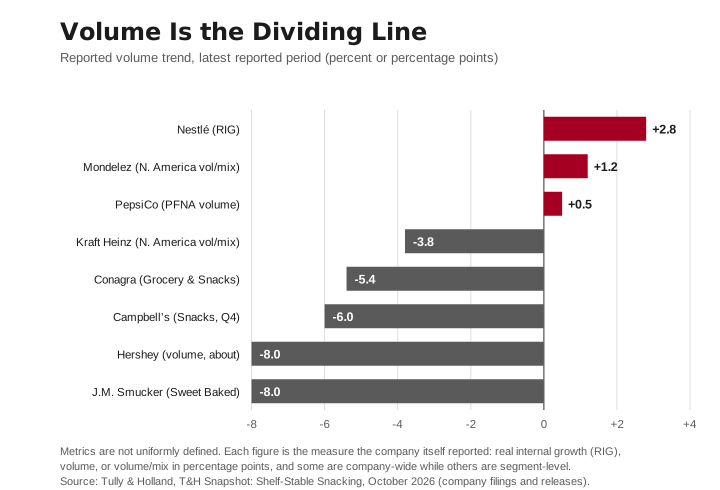
US snack sales grew about 4.8% to roughly $156 billion, and almost none of it came from volume. The companies winning now are the ones selling more units, not charging more for them, and buyers have started pricing the difference.

total US snack sales, with almost all of the growth coming from price and mix rather than volume.
private label's record unit share in the first half of 2026. Store-brand units grew 0.2% while national-brand units fell 0.5%.
points of price against points of volume in Hershey's Q2 2026 North America confectionery business, the sharpest single illustration of elasticity in the report.
the drop in grocery spending within six months of starting a GLP-1, across about 150,000 households. Savory snacks fell roughly 10%, and EY-Parthenon estimates the drugs could remove up to $12B from US snack sales over ten years.
what Smucker has taken on Hostess since buying it for $5.6B in 2023. The cautionary tale for anyone pricing a mature snack brand on last year's revenue.
Siete's tortilla chip dollar sales growth against a flat category. Differentiation still gets paid, even when the category does not.
Executive Summary
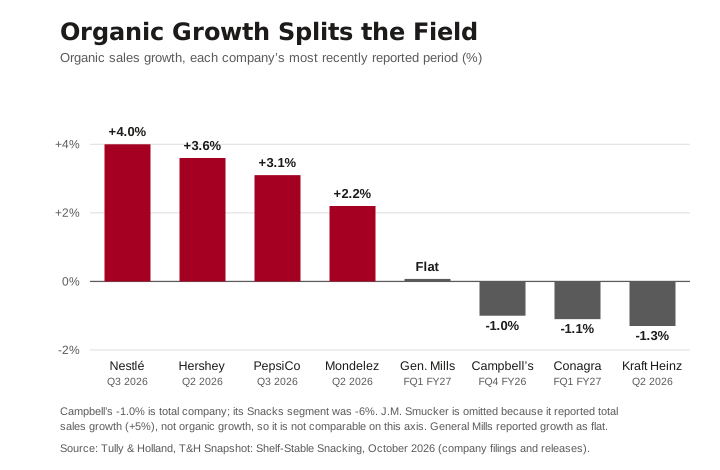
Snacking has moved from a pricing story to a volume fight. After three years of price-led growth, US consumers are trading down to private label, cutting back under GLP-1 drugs and pushing back on price. Companies reporting the strongest recent operating results have either cut prices to win back volume, benefited from easing input costs, or sold into growth niches. Portfolios concentrated in mature US salty and sweet-baked snacks have reported the weakest results.
Recent public results from Nestlé and The Campbell’s Company (formerly Campbell Soup) illustrate the contrast:
- Nestlé reported Q3 2026 organic growth of 4.0%, including real internal growth (RIG, a volume measure) of 2.8%. Its Food & Snacks unit grew 5.0% organically in the quarter.
- Campbell’s reported a 4% organic decline in its Snacks segment for fiscal 2026 (ended Aug 2, 2026), with segment operating earnings down 28%. It recorded $117M of snack-brand trademark impairments in fiscal 2026, after $150M in fiscal 2025, and reduced its quarterly dividend.
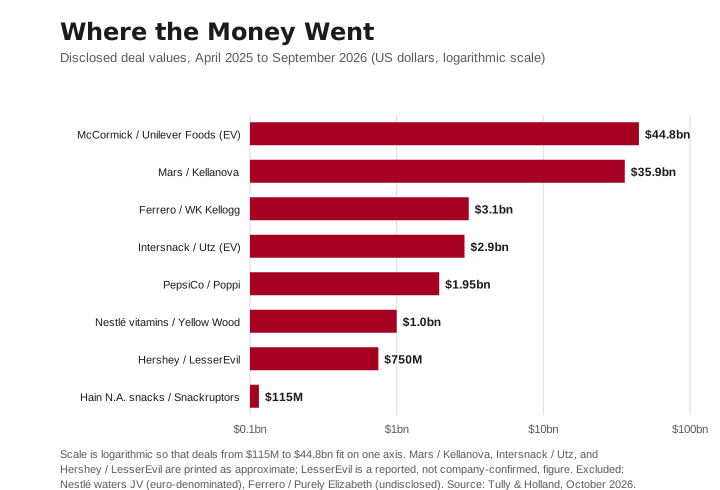
Across the industry, recent transactions show acquirers paying for differentiated growth brands, while slower-growing assets have been divested, impaired or taken private. These patterns suggest portfolio reshaping is likely to remain an active theme in the sector through 2027.
Industry Trends
US snack sales reached about $156B, up 4.8%, but almost all of that came from price and mix rather than volume (Bakery & Snacks). Six forces are reshaping the category:
- Price fatigue and the price-cut cycle. In February 2026, PepsiCo cut prices on Lay’s, Doritos, Cheetos and Tostitos by up to about 15%, and General Mills discounted about two-thirds of its range (OPB). Elasticity is now the central management problem: Hershey’s Q2 2026 North America confectionery sales had +14 points of price and −10 points of volume.
- Private label at record share. Store brands reached a record 23.8% unit share in H1 2026. Private label units grew 0.2% while national brands fell 0.5% (Bakery & Snacks).
- GLP-1 drugs. A Cornell/Numerator study of about 150,000 households found grocery spending fell 5.3% within six months of starting a GLP-1, and savory snack spending fell about 10% (Food Business News). EY-Parthenon estimates the drugs could remove up to $12B from US snack sales over ten years.
- Protein and better-for-you, now crowded. Protein and fiber line extensions are everywhere, from Doritos Protein to SunChips Fiber. But the category is saturated: BellRing (Premier Protein) and Simply Good Foods (Quest, Atkins) have both reported pressure: BellRing lowered its full-year outlook citing competition, and Simply Good Foods reported a 6.3% sales decline in its fiscal Q3. Challenger brands with real differentiation still grow fast; Siete tortilla chip dollar sales rose 21.7% while the category was flat (Snack & Bakery).
- Input costs are turning. Cocoa has fallen to about $5,500–$5,700 per ton in October 2026, well below its late-2024 peak (Trading Economics). Nestlé’s CFO now describes coffee and cocoa as deflationary. After the Supreme Court struck down the IEEPA tariffs, companies are pursuing refunds.
- Policy pressure on demand. SNAP food-restriction waivers will cover about 7.5M households in 19 states by end-2026, putting up to $830M of soda, candy and energy-drink sales at risk (Numerator). Separately, Mars, Hershey and PepsiCo have pledged to phase out artificial dyes or offer dye-free versions under “Make America Healthy Again” (MAHA) pressure.
The result is a flat-volume, promotion-heavy US market where scale, cost discipline and brand differentiation decide who grows. Producers are also closing capacity: PepsiCo, Smucker and Campbell’s are each closing plants or facilities in 2026.
Momentum Across the Sector
Recently reported results show a wide spread in operating performance. Companies returning to volume growth have generally reported stronger results than those relying on price increases or exposed to mature salty and sweet-baked snack categories.
The table summarizes each company’s most recently reported period, based on public filings and releases.
Among challengers, differentiated brands such as Siete keep growing at double digits. Crowded protein brands are struggling: BellRing’s gross margin fell to 27.7% from 35.1% as competing protein shakes flooded the market.
Nestlé vs. Campbell’s
Based on their public disclosures, Nestlé has reported improving volume and margin under new leadership, while Campbell’s has reported declines in its Snacks segment. The two are not like-for-like: Nestlé sold its US confectionery business to Ferrero in 2018, and Hershey makes KitKat under license in the US. Nestlé’s snack exposure is global and chocolate-led, while Campbell’s is a US salty-snack and cracker portfolio.
Nestlé: volume and margin improving
- Leadership reset. CEO Laurent Freixe was dismissed in September 2025 and replaced by Philipp Navratil, formerly head of Nespresso. Chair Paul Bulcke left early; former Inditex CEO Pablo Isla took over in October 2025.
- Volume is back. Q3 2026 RIG of 2.8% beat expectations, and Food & Snacks volume rose 5.4% while pricing eased. Confectionery showed strong volume in the Americas, and KitKat grew in Asia and Africa (Nestlé 9M 2026 release).
- Cocoa relief. Confectionery margin fell to 12.7% in 2025 from 15.4% as cocoa costs peaked. Nestlé’s CFO has described cocoa costs as now deflationary, while noting price pressure from European retailers.
- Cost and portfolio discipline. Nestlé is cutting about 16,000 roles and targeting CHF 3.0bn in savings by end-2027. It has narrowed to four businesses (Coffee, Petcare, Nutrition, Food & Snacks). It is moving waters into a 50:50 venture with Platinum Equity valued at €4.9bn, selling mainstream vitamins to Yellow Wood Partners for $1.0bn, and is in talks to sell its remaining ice cream business to Froneri.
Campbell’s: Snacks segment under pressure
- Salty snacks drove the decline. The company attributed its 6% Q4 organic Snacks decline mainly to salty snacks (Kettle, Cape Cod, Snyder’s of Hanover, Late July) and partner brands. It reported that core Goldfish consumption returned to growth.
- Impairments. Campbell’s recorded $117M of trademark impairments on Kettle and Cape Cod in Q4 FY2026, after $150M on Snyder’s of Hanover in FY2025. These brands came with the 2018 Snyder’s-Lance acquisition.
- Balance sheet. The $2.7bn Sovos (Rao’s) acquisition in 2024 added growth in sauces. The company reported leverage of 4.3x and reduced its quarterly dividend by 36%, stating this would free about $170M a year for debt reduction (Campbell’s Q4 FY2026 release).
- Outlook. Campbell’s guided FY2027 adjusted EPS to $1.65–1.80, down 17–24%, and announced a new $500M cost-savings program through FY2030. Management has publicly referred to possible “tough decisions” on the snack portfolio.
In our view, Campbell’s salty-snack brands, including Kettle, Cape Cod, Snyder’s of Hanover, and Late July, are logical divestiture candidates given recent impairments, declining volumes, and the company’s leverage-reduction priorities. Campbell’s has not announced a formal review or sale process, and this assessment is based solely on publicly available information.
In short, the two companies’ recent disclosures point in different directions: Nestlé is reporting volume-led growth with easing input costs, while Campbell’s is reporting a shrinking Snacks segment alongside cost and balance-sheet actions.
M&A Implications
Deal activity is following the same split: buyers pay premiums for growth brands and scale, while declining assets are written down, sold or taken private.
The cautionary tale is Smucker’s Hostess acquisition: bought for $5.6bn in 2023, it has since taken about $2.9bn of impairments.
Themes likely to shape sector activity:
- Portfolio reviews at large companies. Several large food companies have publicly discussed simplifying portfolios, including Nestlé (waters, ice cream, vitamins) and Kraft Heinz.
- Pressure on slower-growing snack brands. Companies reporting declines and impairments in mature snack brands have generally pointed to cost programs and portfolio choices. Any decision to sell a specific business rests with that company’s management and board.
- Shareholder engagement. Elliott’s reported roughly $4bn stake in PepsiCo led to a December 2025 agreement to reduce US SKUs by 20% and lower prices on core brands (eMarketer).
- Demand for growth brands. Recent transactions show strategic acquirers paying for differentiated better-for-you, protein and ethnic snack brands with proven sales velocity, while generic protein has become a crowded space.
For sell-side advisors, the message to founder-owned snack companies is clear: buyers will pay for real volume growth and differentiated brands, and will discount anything that has relied on price increases.
Text reproduced from the report as published by Tully & Holland.
Keep reading

Consumer Industry Update Q2 2023
Global deal value fell hard in Q2 2023, yet the number of deals getting done rose almost everywhere, and consumer volume...
Read →
Craft Beer Industry Update Summer 2024
Nearly 10,000 US breweries produced $29 billion in 2023 sales, yet production declined for the first time in the modern ...
Read →
Brewer Industry Update September 2019
By September 2019, more than 7,000 craft brewers were competing for a beer market that had stopped growing. Our update f...
Read →