
Brewer Industry Update September 2019
Too Many Taps, Not Enough Thirst
By September 2019, more than 7,000 craft brewers were competing for a beer market that had stopped growing. Our update from that moment captured an industry on the edge of consolidation, with deal structures already changing shape.

operating in the U.S. by 2018, up from just over 1,500 in 2008, roughly a 17% compound annual growth rate over ten years while consumption growth slowed to low single digits.
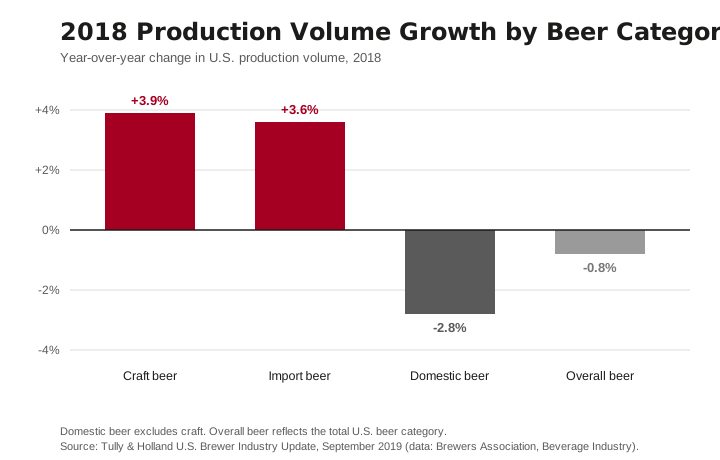
the decline in overall U.S. beer production volume in 2018. Craft (+3.9%) and imports (+3.6%) grew, but domestic beer fell 2.8% and dragged the category down.
beer revenue CAGR from 2008 to 2018, trailing spirits at roughly 3% and wine at roughly 4% as drinkers migrated across categories.
brewer M&A transactions year to date through September 19, 2019, keeping counts near historic highs even as disclosed deal values fell.
minority investments in independent breweries reported since 2017, structured to keep founders in charge and the "craft brewer" designation intact.
the top 10 flavored malt beverage brands in 2018, led by triple-digit gains at Truly and White Claw, the clearest growth story in the report.
In this industry update we will focus on the U.S. brewer industry which includes companies that produce traditional beer, cider, and flavored malt beverages (FMB). The U.S. brewer industry saw production volume declines of approximately 1% in 2018. The declines were primarily driven by declines in domestic light beer consumption and somewhat offset by increased consumption of craft and imported beer, as well as cider and FMB. Growth areas are being driven by younger consumers that have an increasing influence on product innovation and flavor profiles.
Changing demographics allow for new growth areas. Like most CPG industries in the US, the brewer industry is affected by changing demographics. Millennials’ increasing influence upon consumer taste means there has been stronger demand for healthy and sustainable products and brands that are associated with quality, authenticity and heritage. And faster population growth rates within the Hispanic and Asian communities also means that products that appeal to these ethnicities will likely have higher organic growth.
The number of craft brewers has rapidly expanded. There are currently over 7,000 craft brewers in operation in the U.S. The number of operators has increased at a nearly 20% CAGR over the last 5 years while consumption growth rates are slowing. Millennial demand is likely driving the craft beer boom, but data suggests that the market has or at least is starting to become oversaturated.
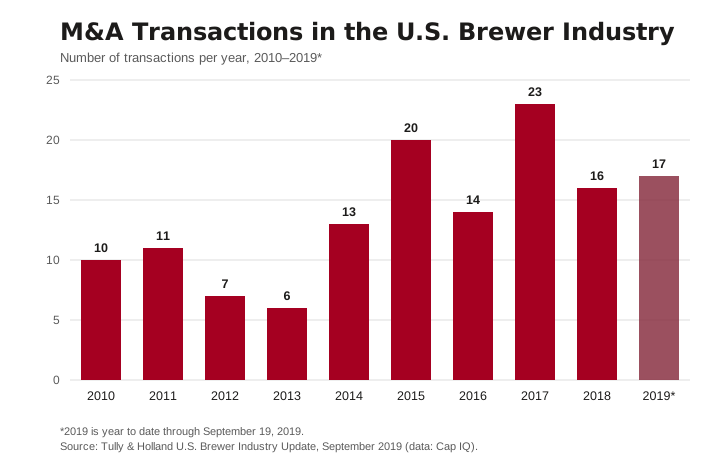
M&A activity remains steady, but deal value is falling. A large number of small-cap transactions continues to keep the M&A environment busy in the brewer industry. We have also seen an emergence of increased minority investments, likely as a result of craft brewers’ desire to remain independent, while sourcing the availability of private capital. There has been a significant decline in outright acquisitions of craft brewers by large strategic buyers given some of the challenges that recent acquirers have faced in taking well-known regional craft beer brands and successfully scaling these brands nationally. As competition increases, we believe that industry consolidation is likely. Any economic downturn should force much more significant levels of consolidation.
Industry Trends
U.S. Beer Industry
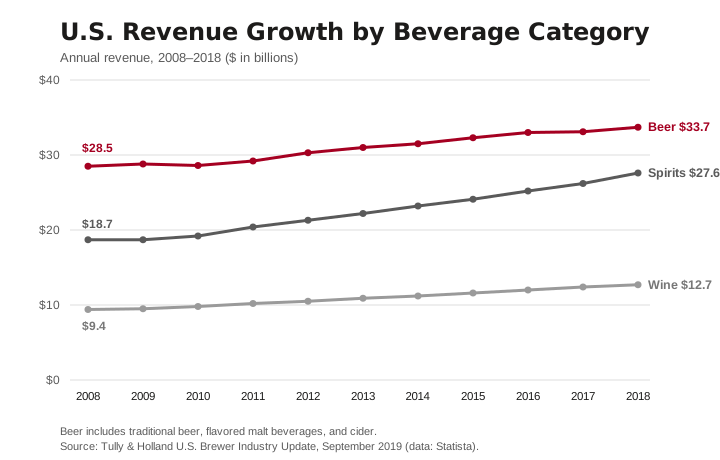
While per capita volume consumption of alcoholic beverages in the U.S. has remained relatively flat over the last ten years, industry revenues have grown driven by an expanding drinking age population that exceeds overall population growth rates as well as a willingness for consumers to pay a premium for specialty craft beer, FMB and cider. Revenue growth in brewer/beer industry, which includes; beer, flavored malt beverages (FMB) and cider, has increased at less than a 2% CAGR, versus the wine and spirits sectors which has increased by ~3% and ~4% CAGR, respectively.
Demographic shifts also explain why the brewer category is losing share to the wine and spirits industry. Sustained growth in the spirits and wine industries is the result of a large baby boomer generation who are shifting away from beer in favor of wine and spirits. The spirit industry is also benefiting from millennials who are attracted to natural and low sugar spirit alternatives such as tequila. The craft brewers’ industry is also benefiting from increasing influence from millennials. Successful new products are commonly either natural, organic, sustainable, healthy, authentic or a mix of them all. The result of these changing preferences is slower revenue growth for “big-beer” which has significant exposure to traditional light beer which is experiencing decreased levels of consumption. Overall beer consumption remains relatively high relative to other types of alcohol as it is comparably affordable and widely accessible.
Brewer Industry
Data from the Brewery Association indicates that overall beer consumption is declining slightly. However, there are certain sub-categories that are growing steadily. Dividing the beer segment into three segments - domestic, import, and craft - we note that both imports and craft beer has gained market share.
Craft and Imported Beer
Craft beer production increased as a percentage of total U.S. alcoholic beverage production volume from ~8% to over 13% from 2013 to 2018. In terms of revenue the category saw roughly 7% percent growth in retail dollar sales in 2018, down from 8% in the prior year. Meanwhile, the number of craft brewers grew by ~13% in 2018. The number of craft brewers has grown at roughly 17% CAGR over the last ten years, increasing the number from just over 1,500 in 2008 to over 7,000 in 2018. The vast majority of the new breweries continue to be small and locally focused, which seems to align well with consumers who increasingly value the importance of heritage and authenticity. In the event of an economic slow-down, we do note that this may pose a challenge for many players in the category as they have little power to compete on price. This suggests the possibility that consolidation is extremely likely in the event of a recession as brewers will look to benefit from economies of scale.
The volume of imported beer has grown at over 5% CAGR between 2013 and 2018. Demographics can likely explain some of the growth. Ethnicities such as Asians and Hispanics are growing more than three times faster than the total US population, allowing for strong organic growth for brands that appeal to these consumers. Mainstream Americans are also seeking additional variety and quality that many of these imported beers offer. Another factor that likely explains growth in the category is the strong USD allowing for lower priced imports. High growth rates in the imported and craft beer segment have taken U.S. market share from the domestic non-craft beer segment which has lost 130 basis points of the market share over the past year.
Data from the Brewers Association and Statista suggests that both the import and craft beer segments are starting to mature – production volume for craft beer dropped from high single digit growth 3 to 5 years ago to more moderate low single digits in 2017 and 2018. The same pattern was seen for the volume of imported beer.
FMB and Cider Categories’
FMB (flavored malt beverages) and Cider are the two products that account for the highest growth rates in the overall brewer industry. The top 10 brands in the FMB category collectively grew volumes at over 12% and dollar sales at over 10% YoY in 2018. Growth was driven by brands such as Truly Spiked and White Claw hard seltzer which both enjoyed triple digit growth rates. The consumption growth of the FMB category, driven by hard seltzers, is attributable to the perceived relative health benefits versus other alcohol categories. Meanwhile, FMBs have become an attractive alternative due to their low calorie and low sugar content. The Cider category also grew at a high pace last year, reversing a three-year decline in volumes. The 10 largest Cider brands grew by 7% in dollar sales and over 10% in volume in 2018. This growth was in part driven by the gluten friendly product promotion of the largest Cider brand Angry Orchard (made by Boston Beer Company).
M&A Activity
General Market Trends
The 5 largest brewers companies hold roughly 80% market share, down from over 90% ten years ago (source: Beer Marketers Insights /NBWA). This shift is largely due to the impact of increased demand for imports and craft beers. Transaction value of deals completed in the brewer industry has declined over the last couple of years but the number of M&A transactions continue to remain high as a result of consolidation on the lower end of the size spectrum. Due to the emergence of an increased number of craft brewers we anticipate continued consolidation through outright sales. At the moment, financings which allow independent breweries to grow are popular. There have been approximately 90 such financings reported since 2017. This type of financing may not be as readily available in future if interest rates rise and there are market liquidity constraints.
One of the more notable transactions YTD 2019, was Boston Beer Company’s acquisition of Dogfish Head Brewery (Off-Centered Way). As explained by Boston Beer’s CEO Jim Koch the acquisition allows them to continue to create the most dynamic and diverse American-owned platform for craft beer and beyond. Dogfish will at the same time get access to a top-ranked sales team and a larger distribution platform. Dogfish’s co-founders have decided to take substantially all of their merger consideration in form of SAM stock signaling their future belief in the combined company. Anheuser-Busch also recently made yet another craft beer acquisition with their addition of Platform Beer Company. The acquisition allows Anheuser-Busch to further increase exposure to the fast-growing craft beer segment, at the same time as it gives Platform access to capital for future growth. Anheuser-Busch states that over the last three years they have injected over $130M post-partnership into their “Brewers Collective” portfolio which consists of 12 different companies.
One trend that Tully & Holland highlighted in its 2018 Global Craft Beer report is the use of minority equity investments to create production and sales alliances between companies to leverage each other’s resources geographically. This trend has continued throughout 2018 and early 2019. Constellation Brands for example acquired a minority stake in Durham Distillery in August 2019. Durham’s product portfolio includes spirits as well as ready-to-drink cocktails - a product with many similarities to hard seltzers. Barrel of Monks Brewing also acquired a minority stake in Odd Breed Wild Ales. The partnerships created by these niche brewers are stated as attempts for increased product innovation.
As stipulated by the Brewers Association, for a brewer to be considered a “craft brewer”, it needs to produce 6 million barrels or less and remain independent (a maximum of 25% can be owned by a non-craft brewer). Due to current consumer consumption behavior we believe craft brewers will likely find it valuable to retain this label and minority investments in craft brewers will continue to be an appealing option. Some breweries prefer to sell equity stakes to private investors and retain their independence, especially when the founder’s continued involvement is paramount. These investors tend to preserve the founder’s tried-and-tested processes, and provide outside support where needed, in areas such as procurement and marketing. This approach can successfully protect the brand’s cachet and identity.
Another potential M&A trend to watch out for is cross-industry M&A between larger, well capitalized brewers and cannabis companies. These business operations, where both industries target similar customers, may realize cost and revenue synergies through consolidation. It would give cannabis companies access to proven platforms within the CPG industry, at the same time it could offer a good customer diversification and brand loyalty strategy for companies in brewer industry. While this is somewhat contingent on easing U.S. regulations surrounding cannabis, we have already seen this type of cross-industry transaction in Canada where regulations are looser. Constellation Brands bought a minority investment in Canadian based cannabis producer Canopy Growth. Constellation brands explained part of their rationale as follows: “The global cannabis market presents a significant growth opportunity…Canopy Growth will benefit from Constellation’s deep understanding of consumer trends and shifting preferences, and proven ability to translate those insights into distinct brand positionings that build strong connections with consumers and foster brand loyalty.”
Historical Transactions
Publicly available data on valuation multiples is limited. In T&H’s experience, transaction multiples that acquirers and investors are willing to pay have trended down in recent years and are quite variable depending on size, growth outlook and perceived ability of brands to appeal beyond a local or regional market. Market dominance within a particular market or region is also a factor.
Publicly Traded Brewers
Public Company Valuation and Trading Performance
In the chart below, we graph our beer index (which includes a universe of global beer companies) versus the S&P 500. As shown, beer industry multiples have contracted since their highs in 2017 as a result of a softening growth outlook for the industry and higher exposure from these companies to the traditional beer segment. Valuations of larger companies such as Anheuser-Busch have benefited from diversification. Currently, the market is applying a valuation premium to businesses such as Boston Beer Company which have a high degree of exposure to craft beer, FMB and other craft beverage alternatives reflecting the underlying growth expectations in these market segments.
Text reproduced from the report as published by Tully & Holland. Photograph: Hongreddotbrewhouse, CC BY-SA 3.0, via Wikimedia Commons.
Keep reading

Craft Beer Industry Update Summer 2024
Nearly 10,000 US breweries produced $29 billion in 2023 sales, yet production declined for the first time in the modern ...
Read →
Craft Beer Year End Report 2024
Craft volumes fell 2% in the first half of 2024 while brewery counts sat at historic highs. Our year end report on why d...
Read →
Kombucha Industry Update Winter 2024
A fermented tea that started on health-food shelves reached $2.8 billion in U.S. revenue in 2024, growing 19.7% a year s...
Read →