
Craft Beer Year End Report 2024
Craft Beer Enters the Age of the Operator
Craft volumes fell 2% in the first half of 2024 while brewery counts sat at historic highs. Our year end report on why disciplined operators, regional roll-ups, and taproom hospitality now define who wins.

the volume decline in 1H24 craft beer sales per the Brewers Association's Mid-Year Survey, with declines felt across channels and regions.
the share of total capacity at which the average brewery was operating, the single number that explains the industry's roll-up wave.
the gross margin climb from 40% to 100% capacity utilization in the report's illustrative brewery model. Utilization is the profit lever.
the share of wholesale revenues that distribution costs can consume, and what hub-and-spoke taproom operators keep in house.
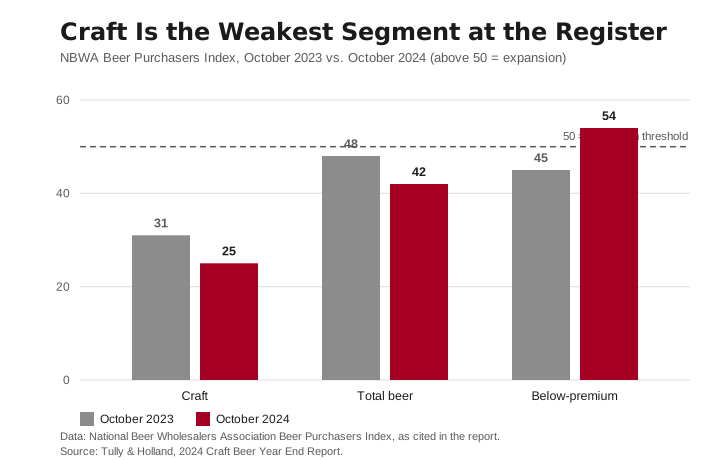
the craft segment's October 2024 Beer Purchasers Index reading, down from 31 a year earlier (above 50 signals expansion).
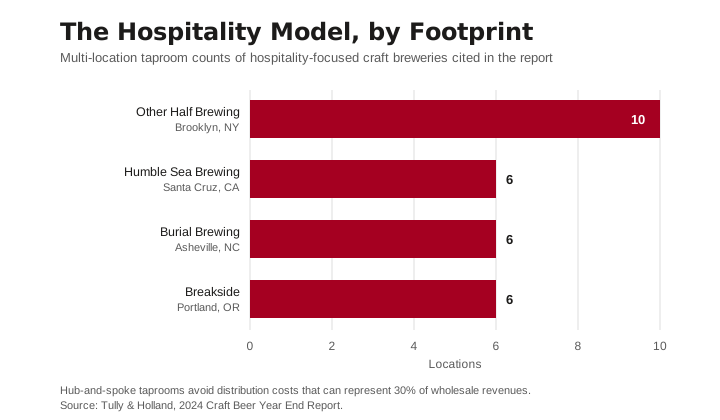
Other Half's multi-location footprint, a marker of craft beer's swing back toward immersive, hospitality-led business models.
Age of the Operator
In this year-end review of the Craft Beer Industry, we highlight key trends shaping the sector. Despite ongoing revenue challenges, we anticipate the industry will stabilize and resume growth after a period of consolidation and business models adapt to a shifting market. We believe we are now in "the age of the operator," where breweries that build strong consumer connections, maintain solid financials, and strategically pursue mergers and acquisitions are well-positioned for success in this phase of the industry cycle.
Industry Trend #1: Craft Beer Sales Continue to be Pressured
In July, the Brewers Association’s Mid-Year Survey reported 1H24 industry sales trended down 2% by volume. Declines were felt across channels and regions although onsite sales were slightly better than distribution sales. This data is consistent with our brewery discussions during the first half of the year. More recently, some brewers we have spoken to have indicated core brand sales declining by double digits on a percentage basis.
Despite this, not all the news is negative. There are brands achieving growth, even amidst broader industry challenges. As Brewer Association Chief Economist Bart Watson noted, “While the category continues to struggle to find collective growth, there are still plenty of success stories in the midyear data." These successes reflect that while consumers have many choices, they are still willing to invest in brands that resonate with them. With a highly competitive landscape, brewers need to consistently align their product offerings and business models with what beer lovers and drinkers are seeking.
Industry Trend #2: Regional Roll-Ups
In response to the craft beer industry’s challenging macro environment, we are seeing a growing trend of breweries being consolidated or “rolled-up” on a regional level. Roll-ups are a logical market reaction in an industry where consumer demand for craft beer is relatively flat or slightly declining, while the number of breweries remains high and at historic levels. The chart below illustrates this imbalance.
Recent Transactions
A recent example of a roll-up transaction and production consolidation is Massachusetts’ The Hendler Family Brewing Group, also known as Jack’s Abby. This year, they acquired two local breweries: Worcester-based Wormtown Brewery and Boston-area-based Night Shift Brewing. Production for both brands has now been centralized at Jack’s Abby’s brewery facility.
Another active acquirer in the craft beer sector has been Nasdaq-listed cannabis company Tilray (TLRY). In 2022, Tilray acquired San Diego-based Green Flash and Alpine Beer Company, relocating their production to its facility in Fort Collins, Colorado. Tilray has continued its aggressive expansion in the craft beer market, purchasing several brands from Molson Coors this year, including Hop Valley, Revolver Brewing, Terrapin Beer Co., and Atwater Brewery.
Importantly, we are not suggesting mergers by themselves are the solution to craft beers current challenges. While breweries are being rolled-up and production is centralized, brewery’s brands must also have a scalable growth strategy based on resonating with an audience while re-focusing on core SKUs. We believe that, alongside some brewery closures, the performance of superior brands and SKU reductions will, over time, help address the current oversupply of craft beer relative to demand.
Production Utilization and Profits
Declining production utilization among brewers has been a key driver behind roll-ups in the industry. According to the Brewers Association, breweries are operating at roughly 51% of their total capacity, making it essential to increase production to become profitable. As production levels rise, brewers benefit from reduced variable costs, such as raw materials. This is particularly advantageous for larger breweries, which are designed for high-volume production but currently face the challenge of underutilized capacity. The charts and table below demonstrate how increased production boosts profitability. As production increases, fixed costs decline as a percentage of total costs due to economies of scale, while per unit variable costs decrease thanks to bulk purchasing efficiencies. The two pie charts below depict the percentage breakdown of each input's cost as a share of the total cost per manufactured barrel.
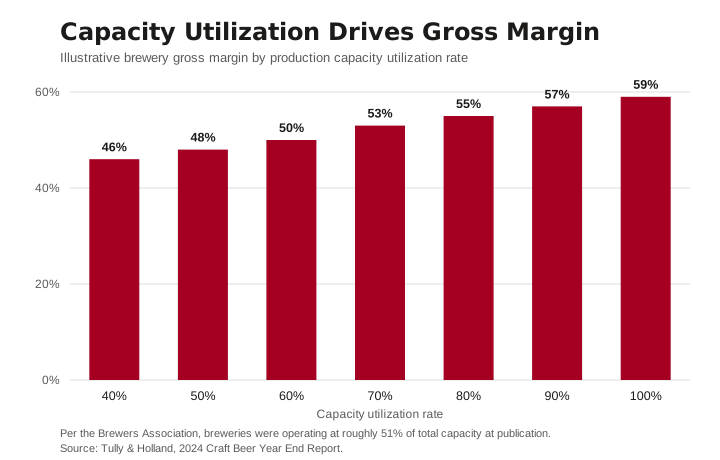
The charts below further highlight the relationship between greater utilization and gross margins.
Other Benefits from Roll-Ups
Regional roll-ups can also act as a catalyst for revenue growth. To begin, by strategically deploying capital, high-performing operators can acquire under-invested, struggling brands, enabling them to diversify their beer offerings and attract new customers. This approach allows operators to not only enhance their product portfolio but also increase market penetration. As an example, brewers can approach their existing on-premises accounts with new styles of beer from acquired brands, thus making it more likely to secure additional tap handles, a clear advantage in the competitive marketplace.
Finally, many acquired brands have their own taprooms or pubs, which enable operators to generate growth from additional revenue streams. We note the press releases of recent transactions, including Jack’s Abbey most recent acquisition, have often called out the number of the acquired brand’s taprooms that will remain open while production is centralized in one location. This multiple location model fosters a direct to consumer, “hub and spoke” business model, which we discuss in more detail below.
Industry Trend #3: The Reemergence of Craft Beer Hospitality Businesses
For craft beer enthusiasts who came of age in the late 1980s and 1990s, the era was marked by craft beer-centric pubs and restaurants. "Microbreweries" with full-service kitchens, such as the still-operating Triple Rock in Berkeley, CA, provided a hospitality experience centered around pairing food with red and brown ales, aiming to build customer loyalty and encourage repeat visits. In contrast, the modern trend has more recently shifted towards 4-pack "hyped" canned releases, characterized by limited editions and weekly drops to generate demand, often facilitated by mobile apps like Oznr.
With the novelty of craft beer waning among younger consumers, some operators are shifting back to an immersive, full-service branded experience through multi-location taprooms. These hospitality focused locations often include in-house kitchens or guest gourmet food vendors, along with food, music, and various events. Examples include Santa Cruz, CA-based Humble Sea, Asheville, NC-based Burial Brewing, NYC- based Other Half and Portland, OR’s Breakside.
These breweries often use a “Hub and Spoke” model, where a central brewery supplies beer to its own satellite taprooms. While some state regulations may limit the number of taprooms one production facility can serve, the cost benefits are clear: breweries avoid distribution costs, which can represent 30% of wholesale revenues. We acknowledge that distributors can offer popular brands reach, scale and growth to a degree that is not possible in a Hub and Spoke model. However, for breweries facing a very competitive retail shelf space environment, the hub-and-spoke model offers a profitable foundation that mitigates competition, reduces margin pressures, and provides an immersive experience that fosters repeat visits. As a result, the desire for direct-to-consumer taprooms is often a key factor behind brewery acquisitions.
To illustrate, we present the performance of three hypothetical brewers. The first two breweries each produce ~50K BBLs annually with 80K BBLs of production capacity. The first brewer sold exclusively through distribution channels. The second brewer derives about a little more than half of its revenue from three company-owned pubs. The third brewer has expanded by acquiring three additional pubs and increasing production by 20,000 BBLs annually. Its revenues are primarily generated through its own locations, and the acquisition has boosted both revenues and margins. This improvement is driven by higher capacity utilization and the fact that most sales occur directly within their own locations, where margins are typically stronger. This third example underscores the revenue and profit growth opportunities that can arise from strategic M&A activity.
Industry Trend #4: Brands without Breweries
Lastly, the industry has seen an increase in contract-brewed brands that operate without their own production facilities. These "asset-light" craft beer brands include the Kelce Brothers Garage Beer (brewed by Braxton Brewing in Covington, KY), Montucky (produced by City Brewing in La Crosse, WI), and San Diego's Modern Times (brewed by Alesmith in San Diego, CA). While some of these arrangements result from the closure of previously owned production facilities, others are part of a deliberate business strategy.
Brands are leveraging the industry’s idle production capacity to bypass costly brewery investments. This approach, often driven by influencers or celebrities, prioritizes rapid audience growth over immediate profits, much like a consumer start-up. The strategy focuses on increasing brand visibility to boost valuation and attract potential buyers.
Expert Opinions
As with our Industry Primer published June 6, 2024, we reached out to experts to provide their observations regarding the craft beer industry. Those who participated included.
- Phil Cutti, Muddy Puddle beer industry consultancy, former President of the Board of Directors, Bay Area Brewer’s Guild, Founder of Headlands Brewing, former Head Brewer at Speakeasy Ales and Lagers.
- Karl Klockars, Co-Founder, GuysDrinkingBeer
- Shane Lohman, Beverage Brand Builder and Distribution Consultant, Founder, Five Star Beverage
"Do you think 2H24 brewery sales have been up, down or about the same on a year over year basis since the Brewers Association reported 1H24 sales volumes down -2%?"
Phil Cutti: "It feels to me that sales are trending to remain on the same trajectory set by the 1st half of the year. As we enter the Fall and Winter months, I anticipate the seasonal decline in sales to continue and possibly by a bit more exaggerated.”
Shane Lohman: “The National Beer Wholesalers Association (NBWA) Beer Purchasers Index (BPI) reported a Total Beer reading of 42 in October. A reading above 50 indicates expansion, while a reading below 50 indicates contraction. While some may point out that this represents an 11-point improvement over September's reading of 31, this interpretation is overly optimistic. The year-over-year decrease from October 2023's reading of 48 underscores a persistent trend of contraction. This contraction is led by the poor performance of the craft segment, which posted a BPI of just 25, down from 31 in October 2023.
As a point of contrast, below-premium beer posted a BPI of 54, nine points higher than October 2023's 45. This highlights a consumer shift that is hard to ignore. Overall, the data suggests that the second half of 2024 continues the downward trend observed in the first half, with little indication of significant recovery.”
"Do you believe brewery consolidation is necessary for the industry to grow again?"
Phil Cutti: I think consolidation is the result of the changing trends in the alcohol industry. It's through these periods that an industry redefines itself and finds opportunities for growth. I cannot help but think that what made the craft beer industry stand out from its corporate counterparts were all the stories the small producers started from and ingrained into their brand. Those stories built the industry, and it will be those stories that ignite future growth and bring in new ideas, opportunities, and life.
Shane Lohman: Consolidation among breweries can provide short-term financial relief and help alleviate immediate business pressures. However, over-reliance on consolidation is dangerous; brands often buy additional sales volume that is as unsustainable as their current sales. This practice can create a temporary revenue bump but fails to address fundamental issues with brand identity, market fit, and long-term strategy. Without effective brand engagement and a compelling value proposition, consolidation is merely a short-lived solution that masks deeper problems.
"What products or business strategies have you seen that are proving successful for breweries?"
Phil Cutti: “I think the breweries that continue to drive home their identity through their product and interaction with their customer base have maintained a loyal following. There is safety in numbers and I am seeing more breweries in a certain vicinity of each other sort of band together for co-opted marketing opportunities.”
Karl Klockars: We're almost at a point where there are no "true" breweries anymore, i.e. ones that only make and sell beer. I think most have learned to embrace the idea that breweries are now beverage makers, where you need at least a hard seltzer, if not a NA option and an RTD cocktail. Craft beer had a good decade and a half when it was new and exciting, but younger drinkers of today have been living in a world full of IPAs since they were in grade school. Locally produced beer is no longer a novelty, and you must have very good beer or a very strong brand to only make beer right now.
Shane Lohman: Blake’s Hard Cider exemplifies a strong, impactful, and scalable brand strategy. Their straightforward value proposition has fueled continuous growth and success. A well-crafted brand strategy positions any brand, regardless of its lifecycle stage, to scale effectively with the right resources.
"What do you make of the success of contracted brewed brands like Garage Beer or Montucky? Do you think we will see more contract brewing going forward?"
Phil Cutti: “I see those brands as Marketing Brands, not necessarily breweries. The large-scale contract production model obviously works but it is a wholly different business model than a brewery that produces their own beer and is using contract brewing as a tool for increased production of a core brand for expanding into a new market or relieving congestion in their own tank farm.”
Karl Klockars: There used to be a mentality in craft beer of "once someone starts drinking craft beer, they're not going to go back to a macro light lager" as though your first IPA was so transformative that you'd never want a Busch Light again. I think we're seeing that that idea isn't exactly holding up. The growth of light lagers is a bit of a regression to the mean, but drinkers are telling beer makers that they don't want a 7% IPA every night. I'm glad to see brands outside of the MolsonCoors and AB-InBev world making inroads with those drinkers through brands like Montucky and Garage Beer, as well as the many, many other regional light lagers emerging from craft brands right now.
Shane Lohman: If I were starting a new beer brand today, contract brewing would be my production method of choice. Contract brewing eliminates the need for initial capital outlays and ongoing operational costs tied to owning production facilities. This frees up cash flow for brand growth and scaling efforts. Additionally, it provides agility, allowing brands to adapt to shifting market demands in terms of production volume, packaging, and format changes. This agility is critical for responding to market feedback and refining strategies for success. Many craft brands are burdened by the capital investments in their facilities, limiting their ability to pivot or scale. A recent conversation that I had with a brewery revealed their struggle: an over $10 million investment in a facility, which now drains their cash flow with heavy debt service payments, leaving them unable to finance new equipment or innovations. Contract brewing prevents such constraints, enabling brands to focus on strategic growth and brand building.
"Is there anything else that has caught your attention or that you think is significant currently in the craft beer industry and worth highlighting?"
Phil Cutti: “Collaborations are on the rise, and I find that interesting. Collaborations used to be sparse, between more local partners, and more on the draft only side. The collab swell has been rising for a couple of years and now it seems they are everywhere. Collabs not only between breweries in different regions but across industries and with various social media partners, etc. On the other end of the spectrum, festivals are struggling and that's tough to see. While the breweries may secretly be fine with not having to donate beer as often anymore, I cannot help but think the decline in attendance at local, regional, and national beer festivals is a trend that we need to correct somehow.”
Karl Klockars: The 19.2oz stovepipe can has been great for sales at some breweries that can pack a 10% IPA into there for $3-$4 per can, but I'm worried that it's going to negatively redefine craft beer for a lot of drinkers. What happens to small, local breweries if people think "IPA" or "craft beer" in general just means "something that can get me hammered quickly and cheaply"?
Shane Lohman: From my eight years in distribution, it’s clear that many brands currently undervalue their distribution partners. They are overlooking the strategic advantage that distribution partners can provide. Distribution is not just a logistical necessity, it’s a partnership essential for creating growth. Brands need to approach distribution with a clear plan, defined success metrics, and continuous support to execute effectively. Without these, brands risk stagnation in an increasingly competitive market. Additionally, brands must innovate thoughtfully, aligning new product development with clear market opportunities and consumer demands. Chasing trends without a solid brand strategy leads to the same underwhelming results that plagued earlier products.
Conclusion
The craft beer industry has shifted to an operator-driven era, where successful brewers stand out by prioritizing audience-focused products, efficient production, and profitable business models. Regionally focused roll-ups can support these strategies. New brands leverage idle production through contract brewing and prioritize rapid audience growth. Our industry experts agree that year-over-year sales have likely declined since the publication of our primer in June. However, they also agreed that craft breweries with strong brands that resonate with consumers can still thrive within the larger beverage industry.
Finally, we feel it is important to acknowledge the devastating impact of Hurricane Helene. Asheville, NC is one of US craft beers richest areas. The damage suffered by the breweries there has been heartbreaking to witness. At the same time, we have been struck by the heroisms of local brewery owners and their employees who have refocused their businesses as centers for their community’s recovery. Burial and Highland breweries are just two of the Asheville breweries we have followed as they try to navigate the enormous challenges of the largest hurricane since Katrina, that has claimed over 200 lives and caused damage upwards of $47B.
Text reproduced from the report as published by Tully & Holland. Photograph: WanderingTrad, CC BY-SA 4.0, via Wikimedia Commons.
Keep reading

Craft Beer Industry Update Summer 2024
Nearly 10,000 US breweries produced $29 billion in 2023 sales, yet production declined for the first time in the modern ...
Read →
Brewer Industry Update September 2019
By September 2019, more than 7,000 craft brewers were competing for a beer market that had stopped growing. Our update f...
Read →
Vitamins & Supplements Update Fall 2022
Nearly 1,800 U.S. supplement manufacturers compete in a market where the top four players hold less than 15% of revenue....
Read →