
Craft Beer Industry Update Summer 2024
Maintaining Is the New Winning
Nearly 10,000 US breweries produced $29 billion in 2023 sales, yet production declined for the first time in the modern craft era. Our Summer 2024 primer on the consolidation phase, and why M&A has become the industry's margin lever.

US craft beer dollar sales in 2023, from roughly 10,000 brewers across all 50 states, the most breweries in US history.
craft's share of US alcohol sales in 2023, up from 3.3% in 2005, while macro beer slid from 47.2% to 37.1%.
average annual production growth from 2017 to 2023, down from 6% to 18% a year during 2005 to 2016. Production declined 1% in 2023.
industry brewing-capacity utilization per the Brewers Association. Half the tanks in America sit empty, which is exactly why combinations make financial sense.
the EV/Revenue range for craft beer transactions at publication, with EV/EBITDA of 4.5x to 5.0x.
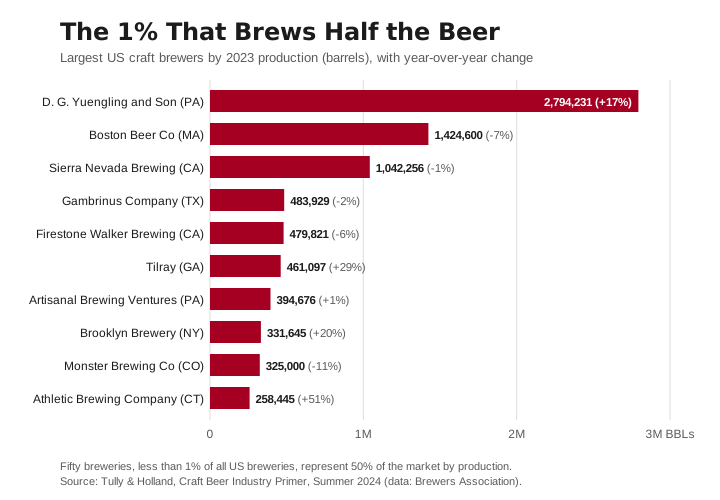
less than 1% of all US breweries account for 50% of the market by production.
Executive Summary
After years of rapid expansion, the US craft beer industry has downshifted into a slower growth trajectory. Factors such as decreased alcohol consumption among Gen Z, competition from other beverage categories and cannabis, and changing consumer demographics has led to the industry’s slowdown. Despite this, the number of craft breweries has continued to grow, nearing 10,000, the greatest number of breweries in US history both in terms of absolute numbers and on a per capita basis.
Our craft beer Primer begins by offering a concise industry overview of the current US market, and then details the industry’s geo-demographics, marketplace trends, and includes an industry expert survey. We then briefly examine craft beer’s competitive landscape, and the industry's current challenges and opportunities. We conclude by reviewing recent transactions and valuations.
In summary, we believe the craft beer industry has entered a consolidation phase typical for an industry after a period of rapid growth. This stage of the current cycle is not dissimilar to the industry’s previous growth cycle during the 1990s to early 2000s. As the market has become more saturated, a singular focus on growth has become less tenable. Instead, maintaining share while improving profitability has taken priority for most brewers. In this operating environment, mergers and acquisitions can help facilitate margin expansion. At the same time, we note buyers have recently shown enthusiasm for breweries that have been able to demonstrate continued growth despite industry headwinds.
Craft Beer Defined
US craft beer is a 40 to 50 year-old industry, whose breweries are defined by the Brewers Association as exhibiting:
- Small Production: Breweries producing 6 million barrels of beer or less annually
- Independent Ownership: Less than 25% of the craft brewery is owned or controlled (or equivalent economic interest) by an alcoholic beverage industry member that is not itself a craft brewer.
- Traditional Brewing Methods: A craft brewery typically emphasizes traditional or innovative brewing ingredients and their fermentation.
Industry Overview
In 2023, US craft beer generated sales of $29 billion by dollar from ~ 10K brewers across all 50 states. After experiencing annual production growth rates ranging from 6% to 18% during the years of 2005 to 2016, industry growth has slowed to an annual average of 2% from 2017 to 2023. Most recently, craft beer production actually DECLINED by 1% in 2023. Despite this slowdown, the number of craft brewery start-ups continued to outpace closures. Since 2005, US craft breweries have increased by an average of 378 breweries a year. Importantly, the annual growth rate in the number of craft breweries from 2005 to 2023 has been 11.2%, which is significantly greater than barrel production growth rate of 5.5%. In short, the industry continues to produce more brewers despite several years of year-over-year flat to declining production growth. We believe this reflects the relatively low barriers to entry for a craft brewery as compared to other businesses. We also believe there is a possibility many brewery owners are part time operators. These two factors have hindered what we believe is a needed rationalization of the craft brewery count.
Geodemographics of Craft Beer Industry
Geographics
Understanding the US craft beer industry’s geographic representation requires a nuanced view that provides insights into its customer demographics. To begin, the top five states as measured by barrel production in 2023 were:
- California: 3,245,189 barrels
- Pennsylvania: 3,132,799 barrels
- Texas: 1,519,691 barrels
- New York: 1,434,992 barrels
- Florida: 1,348,671 barrels
However, these numbers don’t offer a complete picture of the geographic representation of the craft beer industry. A closer look reveals that while the nation’s largest state by population, California, leads in craft beer production (and absolute number of breweries), on a per capita basis Vermont, Maine, Montana and Alaska have the greatest number of breweries per capita.
Demographics
According to a 2018 Harris poll, white males represent the largest ethnic group (58%) of craft beer consumers. This demographic compares to their ~30% representation in the wider US population. Combined with white females (28%), these two groups represented 86% of craft beer consumers as compared to their representation relative to the total US population of 60%. This over indexing of white consumers has parallels with the higher concentration of craft breweries in smaller states with predominantly white populations, as compared to larger, more ethnically diverse states. For the craft beer industry to experience renewed growth, it will likely need to broaden its appeal beyond its current primary consumer demographic. Without making greater inroads with a broader and more diverse audience, the industry will struggle to achieve meaningful growth.
US Marketplace Trends
During the period of 2005 to 2016, the craft beer category grew in popularity among consumers aged 21-49 years old increasing its share of alcohol sales by ~10%. This growth came at the expense of spirits, macro beer and wine.
More recently, consumer trends reflect a softening of craft beer’s popularity among Gen Z consumers. This demographic has instead shown a greater preference for hard seltzer and non-alcohol beverages. We note perhaps non-coincidentally this generational change in beverage preference and desire for new flavors is occurring within the context of Gen Z being a more ethnically diverse consumer group than Gen X or even more recently Millennials.
While craft beer is clearly struggling to reach younger, more ethnically diverse consumers, there are some positive trends within the category. These include new channels for craft beer sales including the convenience store market aided by new formats (single 19.2oz cans), styles (hazy and more recently low ABV lagers), aggressive discounted pricing and non-alcoholic craft beer. For example, large format cans of New Belgium’s Voodoo Ranger Hazy double IPA priced at $3.50-$4.50 have been successful as a grab and go item at retail. Additionally, we note Montucky Cold Snacks, a contract brewed lager, is priced as low as $9.99 for a 12 pack and marketed to more mass, nontraditional craft beer audiences. Finally, the rapid growth of nonalcoholic craft beer brewer, Athletic Brewing, has catapulted them to becoming the 10th largest US craft brewer in less than six years.
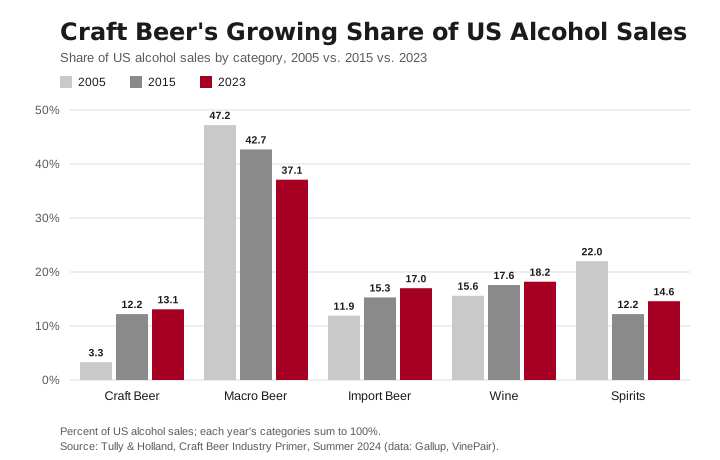
Nevertheless, craft beer is facing a more competitive landscape within the beverage category, as non-alcoholic drinks, seltzers and more recently THC infused beverages are taking share. This corresponds with industry data showing slowing or declining sales volume.
Industry Expert Survey
To help us further understand the current marketplace, we reached out to industry experts to gather their thoughts about the current state of craft beer and what lies ahead. These experts include Doug Veliky of Revolution Beer and author of BeerCrunchers, Brandon Hernandez of San Diego Beer News, and Karl Klockers of Guysdrinkingbeer.com.
Do you believe that 2024 industry sales so far this year are trending above, below or about the same as last year?
Doug Veliky- “You have to look at things a few different ways. I believe volume numbers are very soft but when you look at dollars, the trends aren't quite as bad. The results are very mixed from brewery to brewery, depending on the timing of their own evolution and effectiveness of their strategies. 2023 was a pretty rough year for many, but within are plenty of exceptions. It's a little easier to look good in 2024, if you're comparing to a tough 2023, but to answer your question I believe that industry sales are soft, down a couple percent nationally in dollars, but within striking distance of leveling off.”
Brandon Hernandez- “Though the national craft-beer segment is down a bit as a whole, there have been some signs of pickup, though nothing definitive. When you consider the pandemic, proliferation of shorter-lived alternative alcoholic-beverage disruptors and non-alcoholic beverages, inflation and a challenging economy, I'd say the craft-beer industry is doing fairly well. Many brewers agree with the sentiment that "maintaining is the new winning" as this is a time to focus more on playing defense and staying above water than taking big swings to follow the old game plan of increasing production, adding venues, growing and expanding. Numbers are mostly the same as last year.”
Karl Klockers- “Anecdotally, I have heard winter was rough and lots of breweries are counting on warm weather to help them more than usual. Also, I have noticed more events at breweries to boost sales.”
Are the number of brewery openings/taproom expansions greater or less than closings?
Doug Veliky- “We saw a shakeout in Illinois over the last few years among some of the smallest, with plenty of taprooms closing their doors or stopping producing beer themselves. Just recently we saw the very large Heineken-owned Lagunitas-Chicago facility announce its closure. Whether big like Lagunitas or small like all the local taprooms that closed, each closure has its own story and own circumstances that aren't simply a reflection of the market for craft beer. We continue to see new breweries open like just up the street from me one called Demo Brewing just opened and a Saison focused brand called Is / Was has the city approvals on its own space and taproom, and that's just within a few miles away of me. We ended 2022 with 302 breweries reporting data to the Brewers Association and finished 2023 with 305. Again, the volume is soft so I don't mean to paint too rosy of a picture, but the trends are not stopping the next wave of openings."
Brandon Hernandez- “Without doing the math, last year was a year that saw more closings as businesses consolidated their footprint and risk so as not to be overextended in a tough market and economy. Some companies closed entirely and for good. I just completed an article for the San Diego Union-Tribune detailing the new brewery-owned venues that have opened over the first six months of 2024 and even I was surprised at how many they were and the size/significance of many of them. This year, openings are on pace to far exceed the number of closings, and that includes launches of brand-new brewing companies.”
Karl Klockers- “I see brewery closings followed by new breweries taking over the same production space. As an example, Lo Rez Brewery in Chicago closed, and their space was taken over by Monochrome.“
What are the most common comments you hear from brewers, retailers and consumers with regards to the craft beer industry today?
Doug Veliky- “Brewers right now are often struggling with distribution. Craft beer isn't top of mind for distributors anymore, so they are struggling to get the share of mind needed to increase their distribution, which requires focus. Those who self-distribute are likely to face smaller volumes and rates of sale, making it harder to make the logistical costs work, despite the higher margins in theory, at any sort of efficiency.
Brewers are having the most success when they find ways to align with other communities well beyond the "beer enthusiast" and use their Taprooms as meeting spaces. This allows ways to fill the Taproom and provide a setting for something beyond just socializing over alcohol.
For consumers it depends if I'm talking to current or former beer enthusiasts, or just a casual buyer of craft beer. One thing seems to ring true in both is the desire to reach for lighter, easier drinking options. Adopters of craft beer during its 2010-2015 ascension are ten years older now, more so settled down, and looking for different functions out of their favorite drinks. For casual consumers, the hate of IPAs is very real, and the style is considered synonymous with craft beer by many. Craft beer has been made fun of so much on viral TikTok videos that it could use a new identity if it's going to cycle back to being cool to those currently in their 20's. The idea of local and experiential works very well for the younger generation, but craft beer and IPAs aren't cool to the extent that they once were.”
Brandon Hernandez- “Brewers often lament that they cannot produce the breadth of styles they would like to, and must, for the most part, focus almost exclusively on styles that are in demand, which are IPAs and low-alcohol lagers. Consumer tastes have become so narrowly focused and younger generations seem to have little desire to be adventurous or work to expand their palates. The rainbow of fruit flavors presented by most of the disruptor products (hard seltzer, hard kombucha, ready-to-drink cocktails, etc.) and the popularity of those alternative beverages (though notably fleeting) says a lot about consumers that are coming of age.”
Karl Klockers- “The novelty of craft beer has passed, and consumers are looking for new flavors. As an example, straight forward lagers that are more approachable are popular now, more so than bitter, less approachable beers.”
Recently breweries have started sharing production facilities, merging with other breweries and taking over locations from breweries that have closed. Is this happening where you are? Are you seeing this, as well?
Doug Veliky- “We have a brewery called District Brewyards who contract brews for 4 breweries at a time and has a shared Taproom for all 4 where they each get their own bar. Pilot Project is a related concept to help breweries launch and showcase their beers on tap at a Taproom. But we haven't seen two well-known names join forces like I've seen happen with say Lost Abbey and Mother Earth.”
Brandon Hernandez- “As times have gotten harder and overhead expenses have gone through the roof, breweries -- long innovative and great pivoters, generally -- have gotten creative. There's always been strength in collaborating and banding together, hence breweries sharing facilities and expenses, but I don't foresee this happening all that much in the future. Merging is something that may happen with larger breweries, which are facing the worst algebra in the current economy. As for taking over facilities vacated by shuttering breweries, that has and will continue to occur with great regularity.”
Karl Klockers- “Local breweries are voluntarily coming together to share operational expenses. It’s almost like taking product collaborations one step further.”
Is there anything else you are seeing in terms of new ideas from brewers?
Doug Veliky- “I think ways of showcasing exciting hops but in the form of drinkable lagers is the most exciting trend. There's a lot of different names for the modified approaches from Cold IPA, to West Coast Pilsner, to Lupo Lager. Not enough people know what these are so I wouldn't call them big, but they can deliver something that appeals to the Craft fan but is elevated from traditional beer by being built more so off hops. The convenience store channel is extremely important right now for regional and national breweries, but it is tough to get involved in if you're not with a Bud or Miller/Coors distribution house. Beyond e-commerce, my favorite sales channels involve partnerships with local organizations whether that's minor league sports teams, Zoos, and other venues that welcome in big, wide audiences. Craft breweries can provide the diversity of beverage options and fun programming they're looking for. Also, I'd say that diversity is improving, age probably is not. Finally, more 19.2s for those who can get into convenience, more 12oz cans from those who previously relied on 16oz cans only. Brewery led marketing events and partnerships are the key to getting noticed and engaging new customers so breweries should be looking for new blood in their organization to reinvent what these things can be.”
Brandon Hernandez- “Locally, there's been an incredible interest from brewers and consumers when it comes to beers infused with Pan-Asian ingredients (e.g., pandan, calamansi, ube). Convenience stores are a new important focus for larger brewing companies, and those concerns are going with large 19.2-ounce-and-up-sized single cans. Local breweries are embracing the 19.2-ounce can, as well as other larger can sizes, plus different formats, including an 8-pack of 12-ounce cans. As for events, there are far fewer than there were prior to the pandemic. Consumer interest in beer festivals, in general, is low. That said, truly innovative and unique events garner plenty of interest and sell out.”
Karl Klockers-” I am seeing 19oz silo cans sold individually from small craft brewers in retail stores that I never saw before like gas stations or grocery stores.”
In summary, our experts seem to have expressed common themes. These are:
- In general, the sales environment continues to be challenging this year. Competing beverage types and changing consumer demographics have contributed to this. That said, the experts did not feel sales were down by much.
- Brewery count is still at a break even count or even up on a net basis. Additionally, costs are weighing heavily on the industry and forcing brewers to try different ways to operate. Related, the trend of small breweries combining or sharing production space is just starting and not evenly felt across markets.
- There are hints of where growth may reappear in the form of new adjuncts, flavors and formats. These include hoppier, lighter lagers, selling within new channels including convenience store channels (for some), new venues, and breweries creating marketing events that draw new audiences. Importantly, reaching younger customers cannot be a high ABV, IPA driven effort, if it is going to be successful. New approaches from a product, sales channel and marketing efforts are required.
Competitive Landscape: The 1% and Everyone Else
The craft beer industry is dominated by 50 breweries (less than 1% of all breweries), who represent 50% of the market by production. While some of these breweries such as Boston Beer Co. and Sierra Nevada, have national brands, other large breweries are regional breweries.
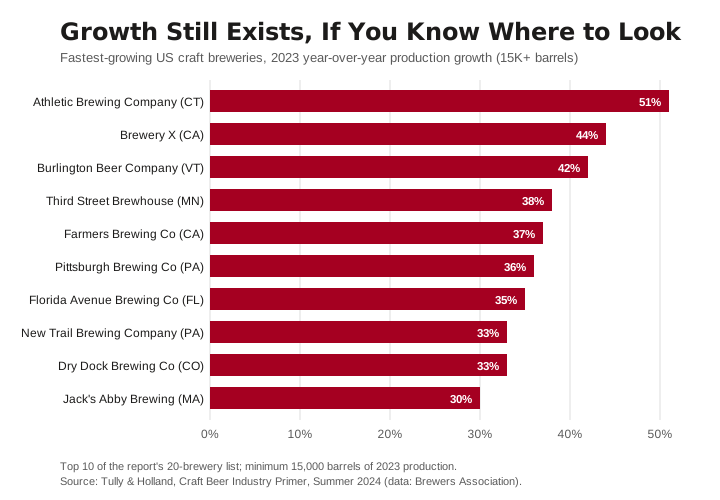
Despite slowing industry sales, there are breweries who are demonstrating superior growth. These breweries are continuing to open taprooms, enter new markets and expand their share in the marketplace and mindshare with consumers. We have highlighted some of them below from 2023. Tilray, a Canadian publicly traded cannabis company has recently grown its presence within the craft beer industry by acquiring several brands that were sold by InBev including Bluepoint, Breckinridge, Redhook and others.
Current Challenges and Opportunities
First Some History: Before we discuss in more detail the challenges and opportunities for breweries today, we think it might be worth reminding audiences of a past cycle. The craft beer industry experienced a boom in the 1990s to early 2000s. Industry sales grew by 15%-25% annually and the number of craft breweries increased by an annual rate of ~25%. Growth was driven by products that included red and brown ales and the proliferation of “microbreweries”. Eventually sales began to decline as market saturation, quality issues, and a recession led to industry consolidation.
Today’s Challenges As we have highlighted above, the challenges faced by the craft beer industry includes decreased alcohol consumption among Gen Z, competition from other beverage categories and cannabis, and changing consumer demographics that have contributed to the industry’s slowdown. We also note there are some similarities with the end of the 1990s craft beer boom. The historic number of breweries continuing to open even as industry production stalls or declines, the ubiquitousness of certain styles of craft beer (hazy IPAs) and challenging economic times for consumers. More ominously, we note some of the craft beer industry headwinds were first experienced within the wine industry. For those who have not read Silicon Valley Bank’s excellent wine industry reports, we recommend doing so. It details the consequences over time of an industry that hasn’t addressed demographic challenges and relies on doing business the same way.
Opportunities: Thankfully craft beer has not entered the degree of challenges that wine has yet. Indeed, there are hopeful examples of innovation and growth that some brewers have experienced. These include expanding into new markets, selling to new, more diverse consumers, and new categories (aggressively priced lagers, 19.2oz single cans and N/A beer).
We also believe that in the current environment, brewers need to shift from an almost exclusive focus on growth to optimizing operations and profitability. This change of focus is essential to ensure long-term viability and economic stability. Thoughtful, strategic operators who recognize the benefits of scale are rewarded in this period of the craft beer cycle. More specifically, the leveraging of excess production capacity with strong brands into new channels while rationalizing SKU counts can drive greater profits. As an indication of the opportunity to improve efficiency, the Brewers Association estimated current brewing capacity utilization of just 51% for the industry. M&A transactions can play a role in facilitating greater efficiencies within the industry.
We are also aware that both industry and consumers have suspicions about craft breweries that become too large and lose their independent spirit. This independent spirit was born during a larger American Food Revolution over fifty years ago. The US craft beer movement began with Fritz Maytag’s purchase of San Francisco-based Anchor Steam Beer in 1965. While we have seen unsuccessful attempts to “roll up” craft beer brands either by strategic or financial buyers, nevertheless we feel a thoughtful merger approach can result in a successful transaction. Important considerations including an appreciation of each brand’s equity, sales channels and unit economics are some of the factors that need to be recognized. We will write more in subsequent industry updates about what we believe are the determinative factors leading to successful M&A outcomes.
Industry Summary
Industry Growth Slows, But Brewery Count Continues To Increase
- After years of growth, US craft beer sales have not only slowed, but most recently declined. Despite this, the net brewery count continues to grow. The number of US breweries is currently at an all-time high.
- More recently, 2023/2024 winter was a very challenging sales period with this year’s summer season viewed as being even more critical than usual for many breweries.
Geodemographic Concentration
- Craft beer consumers and breweries are underrepresented among certain geographies and demographics. Greater diversity geographically, ethnically and by age group will likely be required for industry growth.
Marketplace Trends
- Maintaining share is the new winning for most breweries, as breweries focus on profitability and as competition for shelf space from new beverage categories presents challenges to revenue growth.
- Some brewers are experiencing success with aggressively priced, lager and N/A beers sold to nontraditional craft beer consumers and marketplaces.
- Breweries combining operations and taking over spaces of former breweries are happening across the industry.
Survey Results
- Industry sales environment continues to be challenging this year. This summer season is even more important than usual. Operating expenses also continue to pressure brewers.
- There are hints of growth for some brewers in the form of brewing with new adjuncts, flavors, formats and selling into new channels.
M&A Landscape
We expect to see an incease in M&A activity in the US craft brewery space, driven by industry pressures for consolidation. As the industry focus shifts from growth to profitability, successful brewery combinations will feature strong, complimentary brands while improving capacity utilization, taking advantage of economies of scale, and consolidating resources to improve their bottom lines. As an example, we would point to the merger of the Bay Area brewers Rare Barrel (sours) and Cellarmaker Brewing (IPA focused), that occurred in 2023. More recently, two Massachusetts brewers, Jack’s Abby and (mostly lager portfolio and 40th largest US craft brewery) acquired Wormtown Brewery (mostly IPA focused).
Another type of transaction was recently exhibited by Gallo's recent investment in contract brewer Montucky demonstrates that strategic investors are willing to invest in brewers exhibiting growth by attracting large, new consumer audiences.
Finally, we note articles involving legacy craft beer brands Anchor Steam Beer and Boston Beer Company have been recently purchased or have been subject to rumors of acquisition. There may be other national brands which might become targets of M&A activity. Deep pocket buyers are likely motivated by the belief valuations of large brewers have become attractive, as they currently reflect slowing top line growth. By repositioning these brands within new marketplace channels and bringing scale, buyers believe they can increase brewers' revenue and profitability.
Looking at M&A activity statistics over the past four years shows alcohol beverage deal numbers have recovered strongly after 2021. However, deal size declined slightly in 2023. We believe this reflects a higher interest rate environment that has weighed on valuations. Within the craft beer industry, we believe slowing industry growth and higher interest rates have significantly weighed on deal size. As an example, we note Sweetwater’s $300M acquisition in 2020 by Canadian cannabis company Aphria (now Tilray Brands NASDAQ: TLRY). This acquisition reflected a 4.5x Enterprise Value/ Revenue valuation based on 2019 revenue of $66.6M. Importantly, during 2019 craft beer industry volume sales grew at a 4% rate and the 10-year Treasury bond average yield was 0.89%.
More recently, Tilray paid AB InBev just $85M for eight craft beer brands this past September. This discounted price was based on an implied 1.1x EV/Revenues multiple. The acquisition occurred against a backdrop of 1% declining volume sales for the US craft beer industry and an average 10-year Treasury yield of 3.9%. Despite these industry and macro challenges, the recent acquisition of Anchor Steam and the rumored purchase of Boston Beer Company by Japanese distillery Suntory are indicative of buyers continued interest in the craft beer space. While we believe more M&A deals are forthcoming. in the craft beer space, strategic and financial acquirers will need to be disciplined in their cash spending decision in this challenging macro and industry environment.
Valuation for Craft Beer Brewers
Ideally, EV/EBITDA would be used as a metric along with discounted cash flow for establishing brewery valuations. Thus, for a brewery generating revenues of $10M and EBITDA of $1.5M, to realize $10 million in EV, it would trade for 6.6x EBITDA. Unfortunately, most craft beer transactions are private and EBITDA numbers are not disclosed. As a result, we often only have revenue numbers available from the Brewers Association to use for an EV/Revenue valuation. To get a sense of what size a brewery must be to generate $10M in revenue, we divide this number by the average wholesale price of $400 for a barrel of beer resulting in required production of 25K BBLs per year. To put this amount of production in perspective, we note that of the roughly 9,600 US craft breweries, only ~115, or 1% produce 25K barrels annually. This is not to suggest that a brewery producing less than 25K barrels may not be an attractive acquisition target. Obviously, a brewer may have greater than 15% EBITDA profit margins. Rather, we offer this as a guide to establishing the valuation of breweries in the absence of complete financial statements.
Currently, industry headwinds along with historically elevated interest rates lead us to believe valuations remain below peak ranges a few years ago. However, we do not believe the ~1x revenue multiple seen in the Tilray purchase of former AB InBev brands is a realistic proxy for transactions in the marketplace presently. That transaction represented a repositioning of AB InBev portfolio of brands during a rapid and historic decline of Bud Light sales. Rather, our conversations with market participants on the Buy and Sell Side lead us to believe that EV/Revenue multiples for transactions today are in the range of 1.0x to 1.5x and EV/EBITDA multiples in the range of 4.5x to 5.0x. This wide range of valuations reflects the particulars of each target brewery and perceived value to a potential Buyer.
Selected Transactions Completed in 2023 and 2024
Montucky Brewing – E&J Gallo Winery
- Montucky Brewing is the 40th largest US craft brewer. Its sole SKU is Cold Snacks a contracted beer brewed by a third-party brewer in Wisconsin.
- E&J Gallo is one of the US’ largest wines and spirts distributor. The Montucky investment represents Gallo’s first investment in a beer brand.
- The financial details of E&J Gallo investment in Montucky Brewing were not disclosed.
St. Boniface Craft Brewing – Pour Man’s Brewing
- Operator of a beer brewery based in Ephrata, Pennsylvania. The company specializes in the production and distribution of beers.
- The company was acquired by Pour Man's Brewing for an undisclosed amount on April 30, 2024. The acquisition helps Pour Man's Brewing combine its brewing/wholesale productions, reduce overhead, and be a more efficient business.
Ecliptic Brewing – Great Frontier Holdings
- Operator of two craft brewery locations in Portland, Oregon. The company offers beers, wine and spirits and hosts recurring and special events, thereby allowing customers to socialize.
- The company was acquired by Great Frontier Holdings for an undisclosed amount on November 8, 2023
Funk Brewing – Illumination Brewing
- Producer of hand-crafted beers based in Emmaus, Pennsylvania. The company offers a wide variety of beers, including Funkadelphia (hazy IPA), casual (American lager), strong & pretty (Belgian-style golden strong ale), Cookie Singularity (imperial cookie stout), lemon bikes! shandy (wheat beer with lemonade) and local 99.
- The company was acquired by Illumination Brewing for an undisclosed amount on April 3, 2024. The acquisition helps Illumination Brewing to diversify and enrich its offerings.
Wormtown – Jack’s Abbey
- The company was acquired by Jack’s Abbey Brewing for an undisclosed amount.
- With the purchase, the corporate name will transition to the Hendler Family Brewing Company, which will operate the Jack's Abby Craft Lagers and Wormtown brands, as well as Jack's Beverage Co., the company's contract brewing arm.
Widmer Brothers Brewing – Tilray Brands
- Producer of alcoholic beverages based in Portland, Oregon. The company operates a brewery and is engaged in the processing and distribution of craft beer.
- The company, a subsidiary of Craft Brew Alliance, was acquired by Tilray (NAS: TLRY), a subsidiary of Aphria, for an undisclosed amount on October 2, 2023. The acquisition will enable Tilray to grow its top line and deliver substantial cost savings through synergies, all while significantly expanding distribution to coveted markets across the U.S. and internationally.
Octopi Brewing – Asahi Group Holdings
- Operator of a brewery and restaurant catering to the Waunakee, Wisconsin area. The company offers beer, wine, craft beer, cocktails, whiskey, ale, cider, snacks, appetizers, salads, sandwiches and other related services to its customers.
- The company was acquired by Asahi Group Holdings (TKS: 2502) for an undisclosed amount on January 03, 2024.
High Cotton Brewing – Flyway Brewing, LLC
- Manufacturer of beer based in Memphis, Tennessee. The company's products include Scottish ale, river king IPA, Mexican lager, IPA, Thai pale ale, Belgian IPA, saison and razz wheat.
- The company was acquired by Flyway Brewing for an undisclosed amount on February 21, 2024. The acquisition allows Flyway Brewing to open a new location and expand its presence in the area.
Five Boroughs Brewing – Runneymede Investments
- Producer of craft beer intended to encourage the exploration of beer. The company offers “a variety of beers and makes craft beer for the hidden trails of the Bronx and sprawling Manhattan avenues, enabling consumers to taste beers at a lower cost.”
- The company was acquired by Smuttynose, via its financial sponsor Runnymede Investments, through an LBO on October 23, 2023 for an undisclosed amount. The acquisition is the latest craft-on-craft deal that allows the acquiring company access to new markets and greater efficiencies by consolidating production into one brewery.
DuClaw Brewing – Riverhorse Brewing
- The company's products include craft beer, wheat beer, stout beer and lager which are produced out of Baltimore, Maryland.
- The company was acquired by River Horse Brewing for an undisclosed amount on June 1, 2023.
Ninkasi Brewing – Ashland Seltzer
- The operator of a beer brewery company intended to offer craft beers. The company platform offers seasonal and year-round craft beers.
- The company was acquired by Ashland Hard Seltzer for an undisclosed amount on May 31, 2023.
Melvin Brewing – Roadhouse Brewing Co.
- Operator of beverages and pub intended to provide a line of quality beer experiences. The company manufactures a range of beer products based on craft breweries and offers pub facilities, enabling customers to experience a variety of beer flavors.
- The company was acquired by Roadhouse Brewing for an undisclosed amount on April 13, 2023
Shock Top – Tilray Brands
- Producer of beer based in Saint Louis, Missouri
- The company, a subsidiary of Anheuser-Busch was acquired by Tilray Brands (NAS: TLRY), a subsidiary of Aphria, for an undisclosed amount on August 16, 2023.
Speakeasy Ales & Lagers – Full Circle Brewing
- The company was acquired by Full Circle Brewing Company for an undisclosed amount on April 6, 2023. The deal will bring together Full Circle's portfolio of fruit-forward products with Speakeasy's traditional set of offerings.
Mad River Brewing – Paskenta Band of Nomlaki Indians
- Producer of hand-crafted beer based in Blue Lake, California. The company offers both alcoholic and non-alcoholic drinks along with a taproom that is pet-friendly and a true gathering place, thereby enabling customers to enjoy the weather and drinks.
- The company, a subsidiary of Yurok Agricultural Corporation was acquired by Paskenta Band of Nomlaki Indians for an undisclosed amount in March 2024. The acquisition helps Paskenta Band of Nomlaki Indians to extend its expertise in blending tribal identity and craft beer to the Northern California community and tribes across the nation.
Mac & Jack's Brewing – Ackley Brands
- Operator of a brewery based in Redmond, Washington. The company specializes in the brewing of various types of beers.
- The company was acquired by Ackley Brands through an LBO on September 29, 2023 for an undisclosed amount.
Wachusett Brewing Company – Runnymede Investments, Smuttynose
- Producer of beer based in Westminster, United States. The company's products include Mexican-style lager, wheat, sour, and pale ale, enabling customers to enjoy different tastes of alcoholic beverages.
- The company was acquired by Smuttynose, via its financial sponsor Runnymede Investments, through an LBO on January 19, 2024 for an undisclosed amount.
Text reproduced from the report as published by Tully & Holland. Photograph: Missvain, CC BY 4.0, via Wikimedia Commons.
Keep reading

Craft Beer Year End Report 2024
Craft volumes fell 2% in the first half of 2024 while brewery counts sat at historic highs. Our year end report on why d...
Read →
Brewer Industry Update September 2019
By September 2019, more than 7,000 craft brewers were competing for a beer market that had stopped growing. Our update f...
Read →
Vitamins & Supplements Update Fall 2022
Nearly 1,800 U.S. supplement manufacturers compete in a market where the top four players hold less than 15% of revenue....
Read →