
Seafood Industry Update March 2019
The Consolidation Tide Reaches Seafood
By early 2019, global seafood M&A had climbed four years running and buyers were paying up for vertical integration. Our March 2019 report on the forces that were reshaping one of the world's most fragmented food industries.
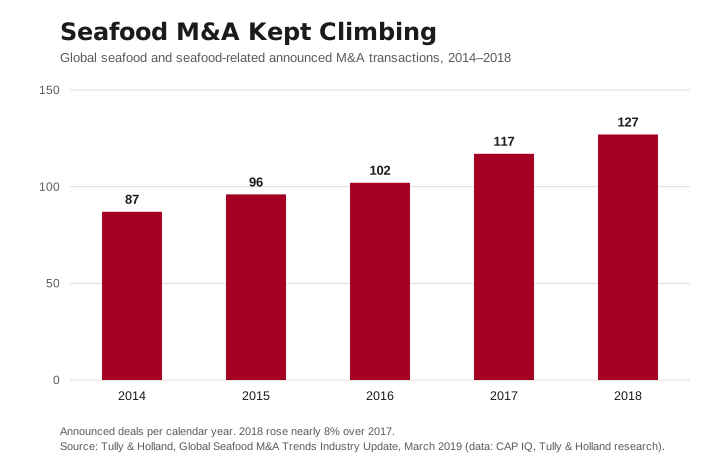
announced global seafood and seafood-related M&A transactions in 2018, up from 87 in 2014 and nearly 8% over 2017.
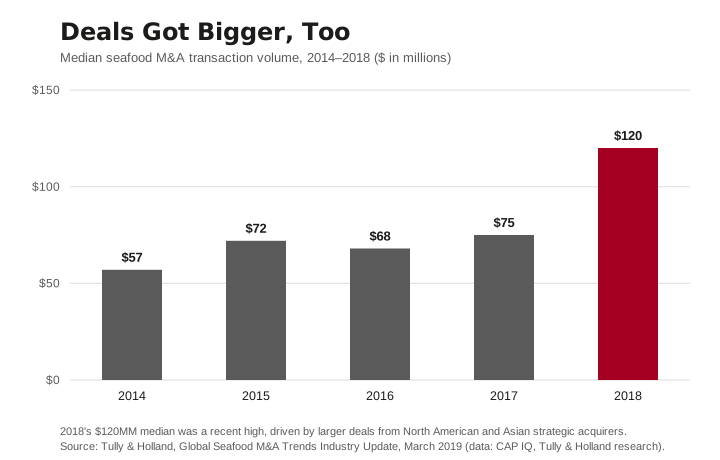
the median transaction volume in 2018, a recent high and more than double the $57MM median of 2014.
the FAO's projected global seafood production, up 18% from 2016, with demand still expected to outrun supply.
the share of world fisheries and aquaculture volume sourced from developing nations, a measure of how fragmented the supply chain remained.
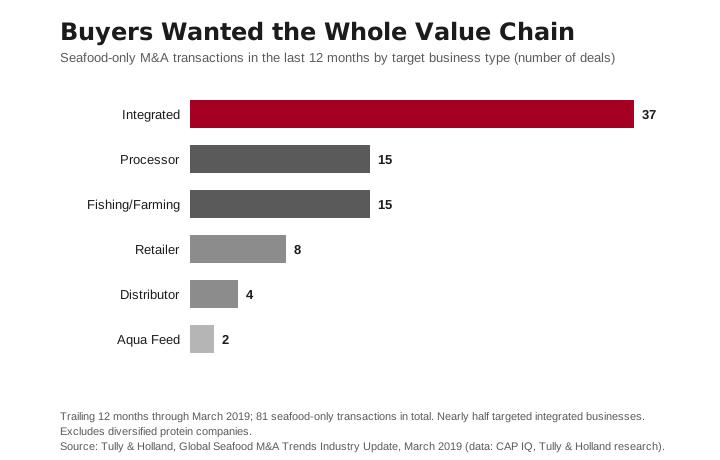
seafood-only deals in the trailing twelve months that targeted integrated businesses, by our tally of the report's deal table. Buyers wanted the whole value chain.
the February 2019 sale of one of Latin America's largest premium shrimp farmers, with Tully & Holland advising the seller.
Overview
Industry Overview
The seafood industry has continued to experience steady growth. In 2016, the combined production from wild caught and aquaculture was equal to 171 million tons. That number is expected to grow by 18 percent to 201 million tons by 2030 according to the State of World Fisheries and Aquaculture (FAO) 2018 report. This represents a 2.1% CAGR, which is slightly above the rate of expected global population growth (1.8%) and below global average GDP growth rates (~3.5%). Global demand for seafood continues to rise driven by population growth, a rising middle class (particularly in developing markets), increased levels of disposable income and a greater emphasis on healthy and “good-for-you” food products.
Given the limits on growth in wild caught fishing due to resource constraints, regulatory oversight and other factors, the marketplace is increasingly reliant on the seafood aquaculture industry to fill the void. Access to large and remote properties, suitable environments, clean water, and control of natural resources remains critical for successful aquaculture businesses, however number of suitable locations is limited. As a result, it is unlikely that supply will be able to keep pace with demand despite technological improvements. This dynamic should continue to support prices among most species for the foreseeable future.
While global consumers have increased consumption of healthy protein products the seafood sector remains highly fragmented relative to other protein sectors. Most seafood supply chains have limited traceability from the point of harvest to the point of consumption. Around 78% of the world’s fisheries and aquaculture by volume is sourced from developing nations according to the FAO report. Asia is by far the largest contributor to global supply, while China, Japan and the US are the largest global consumers. Most seafood is still harvested by independent producers and fisheries, who sell their catch to independent intermediaries. These intermediaries consolidate seafood harvests and sell to independent processors who direct seafood to the appropriate wholesalers and retailers based on particular product specifications.
In the seafood value chain, there is increasing pressure to integrate upstream and downstream operations. Consumers increasingly care about sustainability, origin certification, ease of preparation, food safety assurance and the nutritional value of seafood. As consumers become more discerning about traceability and quality and successful aquaculture practices further stabilize prices, Tully & Holland (“T&H”) expects that larger, well-capitalized international industry players will integrate supply chains and consolidate the market. Meanwhile, smaller players that have not carved out a specific market niche will find it increasingly difficult to compete.
These consolidation trends are already underway. Strategic players in North America and Asia have been gradually expanding into different species as well as moving downstream into processing to create a branded product. Global M&A activity in 2018 eclipsed 2017 levels in both number of deals and volume. Deals include acquisitions of farms, processors, wholesalers and exporters in Europe, the US, Canada, and Asia. Overall activity in this market sector is poised to increase significantly.
Sub-Sector Trends
Wild Caught Fish vs. Farmed Fish
Sourcing wild caught fish is increasingly more challenging and is consequently pushing prices up. Farming is not conducive to many varieties of fish. This has allowed products such as Tilapia and Trout (which can be farmed) to become staples in many store aisles and are increasingly becoming mass market alternatives for consumers. Salmon remains a popular product that continues to fetch premium prices given the long growth cycles and significant investment required to grow the species. Because of this, the introduction of new aquaculture facilities are not expected to have a major impact on prices. Wild caught fish are fetching higher prices given the increasing scarcity value of these products along with the perception of higher quality and better taste. For businesses focused on wild caught fish, there is an increasing trend to integrate with processors to preserve margins and control quality. Total fish processing is forecasted to reach US$222.7bn in value by 2021 and grow at 3.8% per year according to Markets and Markets Research. Volume growth is expected to grow at a 2.2% rate annually which reflects the limits of aquaculture filling the void.
Shrimp
The shrimp business remains under pricing pressure due to the success of intensive and more mechanized farming methods and increasing production volumes which has led to a significant increase in the amount of supply. Meanwhile, demand has not kept pace. This is causing some producers, particularly in the commodity sectors of the market, to consider consolidation. Tully & Holland has been an active participant in advising companies on the sale of their shrimp businesses. We feel that M&A in this sector is poised to increase as prices remain low for the foreseeable future. Shrimp farming production is expected to increase with a 5.7 percent compound annual growth rate (CAGR) from 2017 to 2020. This will result in a global farmed shrimp harvest of 5 million tons.
Lobster
The CETA agreement between the EU and Canada combined with the US trade war with China has had a significant impact on this segment of the market. With US lobster subject to a 25 percent tariff in China, Canada is acting as a conduit market for US lobster and Canadian companies have increasing amounts of leverage. As US exporters try to find alternative markets for lobster exports, prices remain under some pressure in the short run despite lower lobster landings. In the longer the term, the lobster market is expected to grow and, with a limited amount of annual supply, should eventually translate into higher prices.
Shellfish
Significant strides in methods for farming shellfish combined with improving environmental conditions (particularly in developed markets) has supported the production of shellfish products such as oysters, clams and mussels. Increasingly, farmed shellfish is becoming the most important source of supply as demand for these products remain strong. Branding around where these products are sourced is an important differentiator and there is much more consumer awareness and preference around shellfish than around other seafood products. This is a trend we expect to see replicated in other segments of the market.
Seafood Industry M&A Market Trends
Deal Activity
The number of announced Seafood M&A transactions in 2018 increased by nearly 8% versus 2017 levels and has been rising consistently. The median transaction volume reached a recent high of $120MM in 2018 as there were a significant number of larger deals that involved North American and Asian strategic acquirers.
Asia remained the most active M&A geographic region in terms of the companies acquired in 2018. M&A activity has been increasing in Europe, North America and Latin America and there will be more consolidation in the future. In terms of the buyers, large Asian and North American strategic players are driving the global seafood M&A activity.
Because of the increasing levels of consolidation, the seafood industry is becoming more competitive. This will further pressure companies to improve profitability and competitiveness by growing in size as well as cutting cost throughout the supply chain to boost the overall efficiency. In the near term, this consolidation will put further pressure on prices as the industry remains fragmented. In the longer-term, vertical integration will allow the consolidators to have more pricing power.
From the 2018 Seafood M&A Transaction Breakdown, buyers are actively acquiring targets to secure more control over the value chain. There has been a focus on buying companies that offer multiple species within their product portfolio as well as an effort to move closer to the fishing resources and value-added processing.
Recent Notable Seafood M&A Transactions
In March 2019, the Scottish Salmon Company (SSC) acquired Harris & Lewis Smokehouse. This strategic investment will accelerate growth of SSC’s premium brand development in key international markets.
Nolan’s Quality Seafood announced its acquisition of Carr & Sons. Through this acquisition, Nolan will vertically integrate Carr’s processing capacity to its supply chain to create a broader product range.
Empresas AquaChile S.A agreed to acquire Salmones Magallanes S.A/Pesquera Eden Ltda. for approximately $260 million in 2018. With this transaction, Aqua Chile will benefit from the processing plants and ample capacity of the targets.
Union Martin agreed to acquire Fine Fishing in October 2018. With this transaction, Union Martin will add three freezer ships with a combined annual capacity of 3,000 tons to its existing fleet.
Premium Brands Holdings acquired Ready Seafood in September 2018. The Company expects this acquisition to give them proprietary access to sustainable lobster resources and significant innovation.
Bonamar agreed to acquire US shrimp supplier IMS in August 2018 with the goal of expanding its product line and extending its vertical integration. With this acquisition, Bonamar will get closer to its vision of becoming a full-line seafood resource.
Barramundi Asia Pte Ltd completed the acquisition of Marine Produce Australia Limited in August 2018. The transaction is expected to boost Barramundi capacity as well as diversifying farming risks in Singapore.
Cooke, Inc. acquired Seajoy Seafood Corporation group, one of the largest vertically integrated, premium shrimp farms in Latin America, on February 1st, 2019. Tully & Holland acted as a financial advisor to Seajoy Seafood Corporation.
Text reproduced from the report as published by Tully & Holland. Photograph: NewtonCourt, CC BY-SA 4.0, via Wikimedia Commons.
Keep reading

Vitamins & Supplements Update Fall 2022
Nearly 1,800 U.S. supplement manufacturers compete in a market where the top four players hold less than 15% of revenue....
Read →
Consumer Industry Update Q1 2025
Consumer M&A opened 2025 at an estimated $162 billion in global value, food and beverage deal counts jumped 24.1%, and P...
Read →
Kombucha Industry Update Winter 2024
A fermented tea that started on health-food shelves reached $2.8 billion in U.S. revenue in 2024, growing 19.7% a year s...
Read →