
Pet Industry Update January 2026
The Pet Industry Keeps Its Promise
Revenue has grown more than 70% since 2018, and buyers are paying up for the businesses built on recurring care. Our 2026 update on where the pet economy and pet M&A go from here.

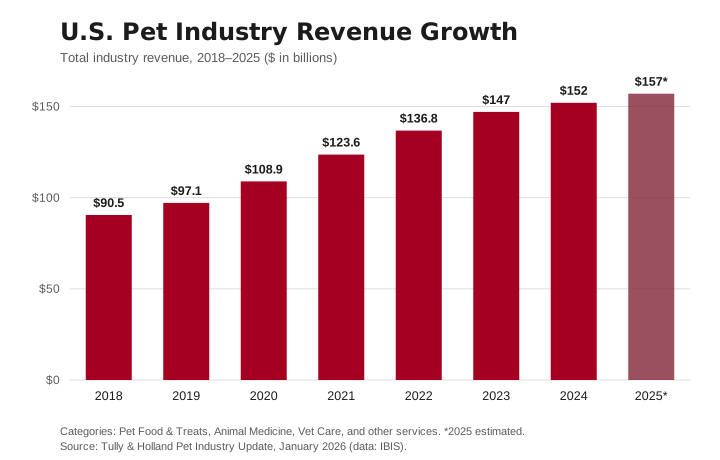
U.S. pet industry revenue in 2025, up from $90.5B in 2018. That growth outpaced inflation: real demand, not just higher prices.
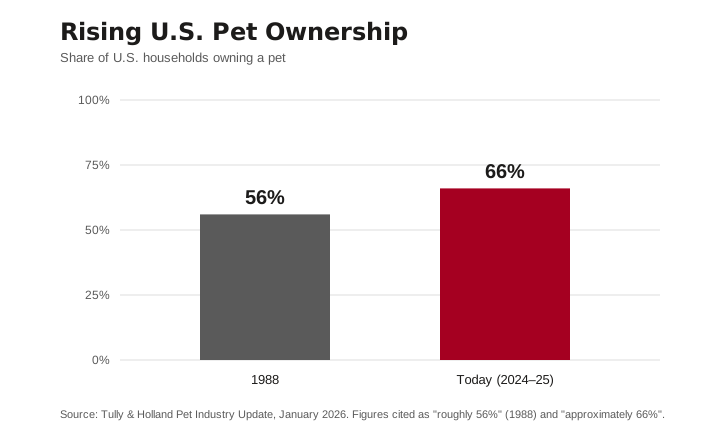
the share of U.S. households that now own a pet, up from roughly 56% in 1988. The customer base itself keeps expanding.
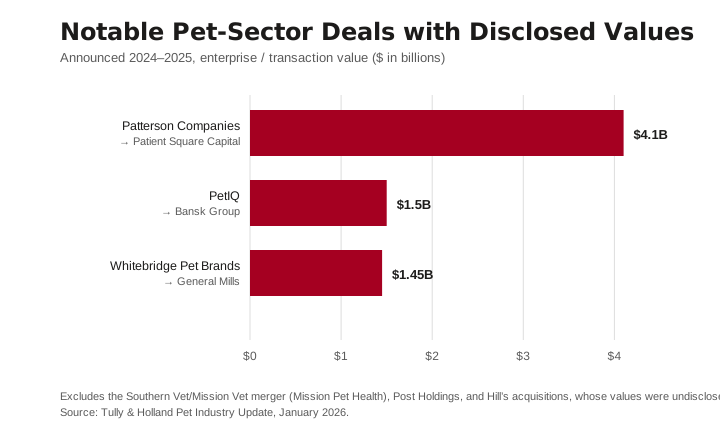
Patterson Companies' take-private by Patient Square Capital, the period's largest disclosed deal.
General Mills' acquisition of Whitebridge Pet Brands. Strategics are paying premium prices for premium nutrition.
the scale of Mission Pet Health after the Southern Vet Partners and Mission Vet Partners merger, a marker of how far veterinary consolidation has come.
toys and accessories softened while vet care, premium nutrition, diagnostics, and subscription essentials grew.
Executive Summary
The pet industry has remained resilient through inflation and shifting consumer spending habits. The industry spans categories such as food and nutrition, veterinary care, grooming and wellness services. Approximately 66% of U.S. households own a pet, up from roughly 56% in 1988, and younger consumers such as Millennials and Gen Z are adopting earlier, spending more per pet, and prioritizing convenience and personalization. As household sizes decrease and the cost of raising a family continues to rise, pet ownership is expected to increase. Industry revenue (Pet Food & Treats, Animal Medicine, Vet Care, and other services) reached roughly $152 billion in 2024 and is believed to have closed above $157 billion in 2025. Notably, Industry revenue growth outpaced inflation, indicating real underlying demand rather than price-driven growth.
While discretionary purchases like toys and accessories softened, spending on veterinary care, premium nutrition, diagnostics, and subscription-based essentials continued to rise. Growth is supported by the humanization of pets, increased focus on preventative care, and stronger demand for science-backed nutrition.
Recent activity in the pet industry shows sustained interest from both strategic acquirers and financial firms. Large consumer and animal health companies such as General Mills and Hill’s Pet Nutrition continue to acquire premium pet food and wellness brands to strengthen their portfolios. Veterinary platforms like Southern Veterinary Patterns and Mission Veterinary Partners are also expanding through consolidation and service diversification. Private Equity remains active heading into 2026, as investors are drawn to strong recurring revenue, resilient, emotionally-driven demand. At Tully and Holland, we expect investment to remain concentrated across veterinary services, nutrition, wellness, and emerging subscription solutions, that add predictability and expand margins.
Industry Overview
The pet industry has evolved into a resilient and steadily expanding consumer market supported by high pet ownership levels, recurring spending, and a growing view of pets as family members (rather than discretionary lifestyle additions). Pet food remains the single largest segment, while the veterinary services segment is growing rapidly, as owners are prioritizing preventative and specialty care. E-commerce platforms and subscription models like Chewy and The Farmer’s Dog have reshaped how consumers purchase food, medication, toys, and everyday essentials. While inflation has softened demand for discretionary items like toys and accessories, spending on nutrition, test kits, and wellness has remained constant or growing, reinforcing the industry’s non-cyclical nature.
Industry composition differs widely by segment. Mainstream pet food is led prominently by large consumer companies such as Mars, Nestle Purina, and Hill’s Pet Nutrition. Premium, fresh, and custom ingredient challengers continue to capture market share. Veterinary care remains fragmented but is undergoing consolidation driven by private equity-backed platforms such as Mission Pet Health, National Veterinary Associates, and Mars Veterinary Health. Grooming, boarding, and daycare services are highly localized but expanding with scalable franchise concepts, while products and accessories remain fragmented with low barriers to entry and increasing private label competition from Amazon, Walmart, and other mass retailers.
Innovation is expanding how and where consumers spend on their pets. Beyond traditional food and annual pet visits, owners are adopting DNA testing, wearable health monitors, telemedicine, pet insurance, subscription-based nutrition, and wellness plans. Brands are competing on science-backed functionality, longevity, and personalization, rather than just flavor or branding. These developments are increasing lifetime spend per pet and shifting the industry from transactional purchasing to ongoing care, positioning the category for sustained long-term growth across nutrition, health, and services.
Drivers and Themes
The pet industry’s continued expansion is supported by both structural shifts in how businesses operate and evolving consumer expectations around pet care, health, and convenience. The following trends reflect the most notable changes shaping both the business models of leading companies and the products driving category growth.
Business Model Trends
Clinic Consolidation
Veterinary care continues to see rapid consolidation as large networks pursue efficiency and scale. The 2024 merger between Southern Veterinary Partners and Mission Veterinary Partners, now operating as Mission Pet Health, marked a meaningful moment for the sector as attention expanded from pure roll-up volume to operational alignment across clinic networks. These platforms are emphasizing doctor retention, service consistency, and quality of care as they integrate acquired practices.
Retail Integration
Retailers are expanding into care and wellness to capture recurring revenue streams and strengthen in-store engagement. Many retailers are transitioning from product-focused models to service-driven platforms that keep owners connected beyond the point of sale. Chewy’s launch of Chewy Vet Care, and Scenthound’s wellness-focused grooming franchises illustrate how retail platforms are evolving to meet owners’ growing preferences for convenient routine checkups for ongoing pet wellness.
Insurance Adoption
Pet healthcare spending continues to rise as more owners seek access to reliable, higher-quality veterinary and specialty care. One of the biggest contributors to this shift is the steady adoption of pet insurance, which has grown meaningfully in recent years and expanded the willingness and ability of owners to pursue diagnostics and advanced treatment options for their pets. This increased financial coverage is strengthening demand across the veterinary ecosystem, supporting investment in clinics, specialty practices, and care-adjacent services.
Subscription Growth
Direct-to-consumer models now play a central role in how pet owners buy and manage essential pet supplies. Personalized meal plans, auto-ship programs, and recurring deliveries have become reliable tools for driving consistent revenue and stronger customer relationships. Subscription-based models make routine care simple while ensuring steady access to food, wellness items, and pharmaceutical products that support daily pet health.
Private Label Expansion
Major retailers and e-commerce platforms are developing in-house pet brands to strengthen margins and build customer loyalty. Amazon’s recent introduction of Wag and Lifelong, along with products from Petco and Walmart, demonstrate how companies are bringing production and formulation closer to their core operations to better manage pricing and quality. These offerings emphasize attributes like “Made in the USA”, grain-free recipes, and premium packaging to appeal to recent trends in health-conscious pet owners. Private-label expansion is becoming a core growth lever for large retailers, helping them protect margins and stay competitive in an increasingly crowded pet care market.
Product Trends
Humanization & Emotional Spending
The emotional connection between owners and pets continues to deepen, with pets increasingly viewed as family members rather than companions. This shift underpins consistent spending even during periods of economic uncertainty, as owners prioritize pets’ health, comfort, and quality of life. Brands are leaning into this emotional spending with marketing that highlights shared experiences and wellbeing, positioning pets as active participants in household lifestyles.
Premiumization
Pet owners are trading cheap kibble to premium, science-backed food and wellness products that emphasize function and transparency. Companies such as The Farmer’s Dog, Freshpet, and Native Pet have redefined quality expectations with human-grade ingredients, functional nutrition, and personalized meal plans. Similarly, General Mills’ acquisition of Whitebridge Pet Brands highlights how major players are reinforcing their portfolios around premium offerings that promise measurable health benefits.
Preventative Care
Consumers are increasingly adopting a proactive approach to pet health, seeking products and services that prevent issues rather than treat them. This includes diagnostic testing, supplements, and regular wellness checkups, often supported by data-driven insights and veterinary guidance. Companies such as Everfur.com and Whistle are responding to this trend by integrating early detection and continuous health monitoring into their service models, strengthening customer relationships and encouraging long-term engagement.
Convenience & Customization
Convenience has become a defining feature of the modern pet industry, shaping how products are distributed, packaged, and experienced. Retailers and brands are simplifying ownership through streamlined shopping, bundled assortments, and efficient fulfillment models. BarkBox reflects this shift by turning spontaneous or occasional purchases such as toys and treats into an effortless, preselected shopping experience that appeals to busy owners. Across the category, the emphasis on speed, accessibility, and low-effort engagement continues to reshape how consumers discover and shop for pet products.
Sustainability
More pet owners are beginning to pay attention to how products are made and whether companies are taking steps to reduce unnecessary waste. Shameless Pets is a clear example of this shift, creating dog and cat treats from fruits and vegetables (as well as other surplus ingredients) that would otherwise be thrown out. The brand brings this practice to life through familiar treat formats that make sustainability easy to adopt. As interest in lower-impact options grows, upcycled formulations are becoming a credible point of differentiation within treat aisles.
M&A Landscape Overview
The pet industry continues to attract strong M&A activity from both strategic and financial buyers, driven by the sector’s non-cyclical nature and stable consumer demand. Despite a tighter financial environment, transaction levels remain well above pre-pandemic averages as investors seek exposure to categories with recurring revenue, margin stability, and long-term growth potential. Companies across the ecosystem, from veterinary care to premium nutrition and wellness, are drawing buyer interest for their ability to capture consistent revenue even in challenging economic conditions.
Strategic acquirers are targeting complementary assets that deepen their position across established categories such as consumables, veterinary services, and diagnostics, while also expanding into adjacent wellness and health-driven segments. Large consumer goods and healthcare companies continue to view the pet space as a natural extension of their existing portfolios, leveraging brand scale, distribution, and R&D capabilities to drive growth.
Private equity sponsors remain highly active, particularly in service-based and recurring revenue models that offer scalable unit economics and strong customer retention. Roll-up strategies in veterinary care, diagnostics, and pet health services continue to account for a meaningful share of deal flow, while new platforms are emerging around preventative health, e-commerce, and private-label manufacturing.
While valuations have moderated from their pandemic-era highs, quality assets with strong profitability and differentiated positioning continue to command competitive multiples. As capital conditions stabilize, both strategic and financial buyers are expected to maintain strong momentum through 2025 and 2026, with heightened focus on platform scalability, margin resilience, and customer loyalty.
Notable Recent Transactions
- Leading distributor of dental and animal health products and services across North America, serving both clinics and veterinary practices.
- Acquired by Patient Square Capital for approximately $4.1 billion
- The acquisition supports Patient Square’s strategy to build scale in healthcare distribution and recurring service revenue, while positioning Patterson for long-term operational and M&A-driven growth
- Provider of pet medications, OTC products, and wellness clinics across retail and e-commerce channels. The company also provides pet nutritional supplements under the PetArmor, Rocco & Roxie, VetIQ, Minties, and Sentry brands.
- The company was acquired by Bansk Group in October 2024 for $1.5 billion.
- The transaction expands Bansk’s platform in affordable pet health and wellness leveraging PetIQ’s manufacturing capabilities and value-driven clinic network to reach cost-conscious customers.
- Southern Veterinary Partners and Mission Veterinary Partners, two leading U.S. veterinary groups with a combined network of over 1,000 clinics, merged in 2024 to form Mission Pet Health. The merger creates one of the nation’s largest veterinary care platforms.
- The merger was backed by Silver Lake and Shore Capital Partners.
- The newly formed company enables operating efficiencies, shared technology infrastructure, and a broader reach across preventative care, diagnostics, and specialty services.
- Manufacturer of premium, natural pet food and treat brands, including Tiki Pets, Cloud Star, and Grizzly. Whitebridge operates across North America with a strong foothold in the holistic and grain-free categories.
- The company was acquired by General Mills for ~$1.45 billion in 2024.
- The acquisition expands General Mills’ pet portfolio, positioning the company to capture growth in the premium nutrition space and strengthen its presence in the fast-growing, health-focused pet consumables segment.
- U.S.-based co-manufacturer and private label producer specializing in dry and baked pet foods for branded CPGs, retailers, and emerging DTC brands.
- The company was acquired Post Holdings in 2024 for an undisclosed amount.
- The acquisition enhances Post’s manufacturing scale and diversification, aligning growing demand for domestic private-label capacity and turnkey solutions among established pet food brands.
- Australian pet food manufacturer specializing in therapeutic, vet-guided fresh nutrition for dogs and cats, offering functional meal solutions for allergies, digestion, and chronic health conditions.
- Acquired by Hill’s Pet Nutrition (Colgate-Palmolive) in 2025.
- The acquisition supports Hill’s entry into the fresh and prescriptive-grade category, advancing its strategy to provide clinically backed, science-driven pet wellness products globally.
Conclusion
The pet industry continues to offer a compelling landscape for both acquirers and operators as consumer behavior shifts toward higher-quality nutrition, preventative health, and convenient service models. The trends outlined in this report reflect a category that has evolved beyond traditional products and is now anchored by wellness-driven demand, premium spending, and recurring engagement. Ongoing M&A activity reflects this momentum, with buyers targeting assets that pair strong fundamentals with clear avenues for growth. Businesses that can execute consistently, scale efficiently and remain relevant across evolving consumer expectations are well positioned to outperform. Looking ahead, companies that deliver measurable value to pet owners while maintaining quality and reliability will continue to stand out in a market defined by stability. As these trends accelerate, at Tully & Holland, we believe that there will continue to be meaningful opportunities for founders, operators, and investors to create value across the pet ecosystem.
Text reproduced from the report as published by Tully & Holland. Photograph: Nenad Stojkovic, CC BY 2.0, via Wikimedia Commons.
Keep reading

Vitamins & Supplements Update Fall 2022
Nearly 1,800 U.S. supplement manufacturers compete in a market where the top four players hold less than 15% of revenue....
Read →
Healthy Food & Beverage Update April 2019
In every deal-size bracket we measured, healthy food and beverage companies sold at higher EV/EBITDA multiples than thei...
Read →
Kombucha Industry Update Winter 2024
A fermented tea that started on health-food shelves reached $2.8 billion in U.S. revenue in 2024, growing 19.7% a year s...
Read →