
Healthy Food & Beverage Update April 2019
The Better-for-You Premium
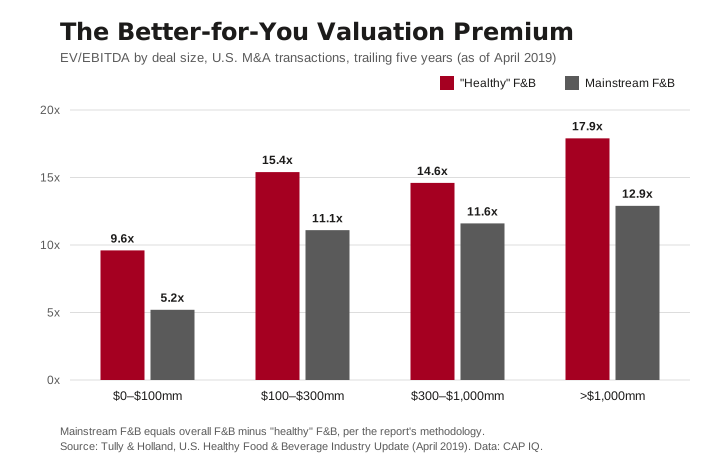
In every deal-size bracket we measured, healthy food and beverage companies sold at higher EV/EBITDA multiples than their mainstream peers. Our April 2019 report on the deal wave that made "better for you" the most valuable label in food.

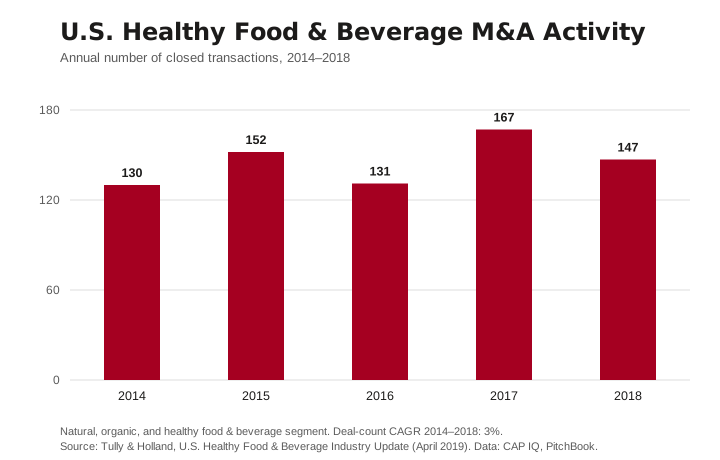
closed US healthy food & beverage transactions in 2018, 12% below 2017's record of 167 but 12% above 2016's count.
five-year EV/EBITDA on deals above $1 billion, healthy versus mainstream food and beverage. The premium held in every size bracket.
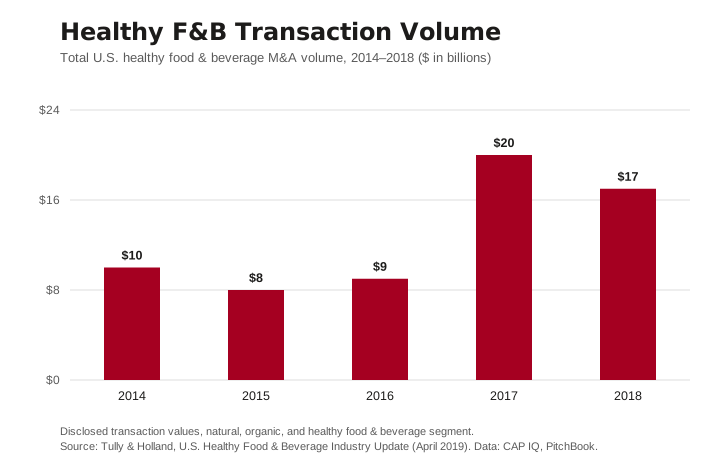
total healthy F&B transaction volume in 2018, roughly double the $8 to $9 billion pace of 2015 and 2016.
Danone's acquisition of plant-based producer WhiteWave at 24.8x EBITDA, the largest deal in the report.
General Mills' purchase of Blue Buffalo at 6.3x revenue and 25.6x EBITDA, proof the premium extended to healthy pet food.
healthy deals as a share of all US food & beverage transactions in 2018 (147 of 411, our computation from the report's data).
Overview
Industry Overview
The natural, organic and healthy food segment has seen tremendous growth recently when compared to historical norms for the overall food industry. As consumers have adopted more healthy eating habits, the growth of the natural, organic and healthy food segment has sky rocketed.
2019 Food Trends
- Healthy Eating: Organic, raw, gluten-free, non-soy, dairy-free, non-GMO, no additives, sugar free and high protein products are in high demand.
- Plant-based Protein: Proteins and superfoods such as quinoa and chia seeds as well as partial proteins such as peas, broccoli and spinach have become increasingly popular with consumers.
- New Flavor Combinations: As the world becomes more globalized, consumer preferences trend towards more unique international and ethnic flavors and away from traditional flavors of the past.
- Convenient Single-Serve Snacks: Healthy single serve snacks have grown in popularity with consumers increasingly on-the-go lifestyle. These snacks often serve as portion-controlled meal replacements.
- Transparent Ingredients: Consumers want to know what goes into a product, where it comes from and what steps a company took to ensure the product is made or grown ethically, while delivering the health benefits that they seek.
- Sustainability and Social Responsibility: Consumers are increasingly interested in buying products from companies that exhibit strong social responsibility and are highly sustainable and transparent in their supply chain.
- Kid-Friendly Snacks: Parents are careful about what they give their children and as work weeks expand, parents have less time to prepare snacks, leading them to buy healthy on-the-go snacks instead of preparing themselves.
2019 Beverage Trends
- Naturally low sugar: As more people monitor and cut back on their sugar intake, companies have been challenged to adapt and deliver beverage formulations that meet a range of expectations. Sweet low-calorie options such as agave, stevia and monk fruit are replacing high fructose corn syrup and pure cane sugar. People also prefer natural juices over synthetic or “bad for you” sugar alternatives.
- Ready-to-drink: Energy and sports drinks, drinkable yogurt/fermented beverages & coffee drinks are the top categories for functional & healthy claims, and as a result have been showing strong growth.
- Plant-based ingredients: Soy and pea proteins, used in smoothies and shakes, have grown in popularity as plant-based ingredients of choice.
- Protein, Vitamins & Probiotics drinks: Healthy single serve snacks have grown in popularity with consumers increasingly on-the-go lifestyles. These snacks often serve as portion-controlled meal replacements.
- Sparkling drinks (Seltzer): Hard seltzers, the feistier cousins of non-alcoholic sparkling waters like LaCroix, are surging in popularity. Less-sugary seltzers are likely to continue booming as more American consumers reach for products, they consider to be healthier.
- Cannabidiol (CBD): CBD is appearing in cold-brew coffee, tea, beer, lemonade and more. Manufacturers claim that CBD beverages will provide “functional chills,” and “natural” ways to de-stress.
M&A Market Trends
Deal Activity
US M&A transactions in the natural, organic and healthy food & beverage segment recorded 147 closed transactions in 2018, 12% lower than the record high of 167 transactions in 2017, but 12% higher than 131 transactions in 2016. The CAGR of natural, organic and healthy M&A deals from 2014-2018 has been 3%. The share of healthy food & beverage M&A transactions has been also growing as a percent of total food & beverage deals. Large food & beverage companies have been reshaping their strategies by acquiring better-for-you companies or selling off assets to become more focused, growing streamlined businesses. There have been many strategic acquisitions in the healthy food & beverage segment where small rapidly growing companies with healthy, good-for-you, innovative products are acquired by large strategic buyers. Rather than increasing their R&D spending on new products with high risk of commercialization, strategic buyers have elected to expand their portfolio through M&A.
2019 Notable M&A Transactions
The Hershey Company’s $1.5B purchase Amplify Foods for 4.1x revenue and 18.5x EBITDA on January 31, 2018.
Danone’s purchase of natural and plant-based food producer WhiteWave for $10B at a 3.0x revenue multiple and a 24.8x EBITDA multiple and on February 23, 2018.
General Mills purchased organic pet food producer, Blue Buffalo Pet Products for $8B at a 6.3x revenue and 25.5x EBITDA multiple illustrating the overall strength of the healthy pet food market.
PepsiCo/Frito-Lay agreed to purchased Bare Foods on May 25, 2018 for an undisclosed sum in a deal expected to close this year.
NU Pet Company, a subsidiary of Smucker’s, entered into a definitive agreement to acquire Ainsworth Pet Nutrition from L Catterton and the Lang Family for $1.9 billion on April 4, 2018.
PepsiCo has agreed to acquire countertop carbonated water machine maker SodaStream for $3.2 billion.
Keurig Dr Pepper entered into a definitive agreement to acquire the remaining 94.9% stake in Core Nutrition, LLC for approximately $450 million on September 27, 2018.
The Kraft Heinz Company entered into a definitive agreement to acquire Primal Nutrition, LLC for approximately $200 million on November 29, 2018
PepsiCo has agreed to acquire Health Warrior, Inc. on October 31, 2018 for an undisclosed amount.
PepsiCo has agreed to acquire CytoSport from Hormel Foods Corp. on February 19, 2019 for $465 million.
Valuation Trends
M&A Transactions
Not only has the demand for deals been strong, but also the multiples at which natural, organic and healthy food & beverage companies have traded have been increasing over the same period. The breadth and depth of these deals shows across the board strength in M&A of companies in the natural, organic and healthy food and beverage segments. Consumers are increasingly more informed about the benefits and impacts of healthy eating and are willing to shift their purchasing decisions towards “better-for-you” options where differentiation can add significant value.
When comparing healthy food & beverage companies to mainstream food & beverage companies over the past 5 years in different size categories, the “healthy” sector enjoys significantly higher EV/ EBITDA valuations in every segment.
Text reproduced from the report as published by Tully & Holland. Photograph: Jannis Brandt _jannis, CC0, via Wikimedia Commons.
Keep reading

Consumer Industry Update Q1 2025
Consumer M&A opened 2025 at an estimated $162 billion in global value, food and beverage deal counts jumped 24.1%, and P...
Read →
Beverage Industry Update Q2 2026
The strategics have stopped waiting for internal innovation to catch the growth brands. From PepsiCo's $1.95 billion pur...
Read →
Consumer Industry Update Q1 2026
Global deal value set an all-time record while capital crowded into a handful of megadeals, and healthcare capital inves...
Read →