
Beauty Industry Update Fall 2023
Beauty Behaves Like a Necessity
The industry erased its pandemic losses within two years and kept growing straight through the inflation shock. Our Fall 2023 report on where beauty's growth, indie-brand innovation, and M&A appetite stood, and why the lessons still matter to owners.

where analysts cited in the report saw global beauty retail sales landing by 2027, a 6% annual growth rate off the 2022 base.
the average EBITDA margins the category delivers, a big part of why buyers keep coming back to beauty.
US beauty and cosmetics manufacturers, with the top five players holding a combined 40% share. Low concentration leaves real room for independents.
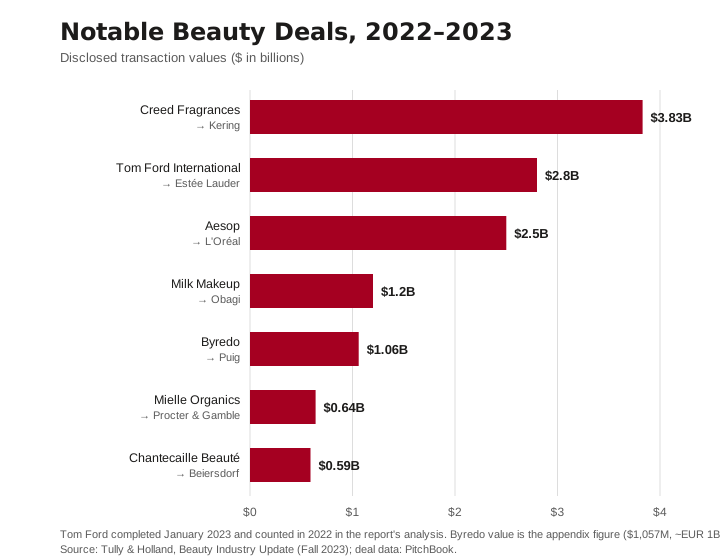
L'Oreal's 2023 acquisition of Aesop, one of two megadeals in the report alongside Estee Lauder's $2.8B purchase of Tom Ford.
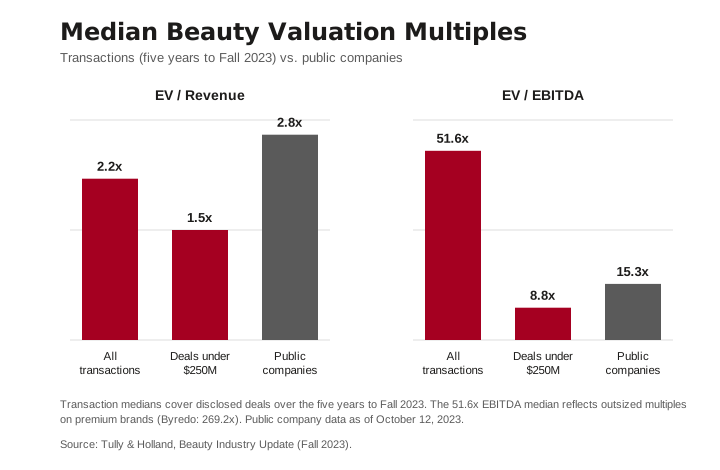
median EV/EBITDA on transactions under $250 million over the five years to Fall 2023, a far steadier band than the headline-grabbing premium-brand multiples.
of 78 funded indie beauty brands McKinsey tracked, 56% had not reached $100 million in sales as of May 2023, and another 31% had gone out of business.
Executive Summary
The Beauty industry – broadly defined through its four main segments: skincare, haircare, makeup, and fragrance – has proven its resilience in challenging economic conditions over the past three years. Despite being a mature and competitive industry, Beauty offers compelling opportunities for innovation and growth to companies that can anticipate and play into emerging trends. Such trends include the broad consumer demand for clean, natural, sustainably sourced ingredients and packaging, as well as more industry-specific phenomena, like the development of premium and personalized formulas.
From an M&A perspective, recent dealmaking activity clearly demonstrates that strategic buyers – predominantly large Beauty conglomerates like L’Oréal, The Estée Lauder Companies, and Coty – are heavily relying on acquisitions to augment their product portfolios and remain relevant to consumers. Interest from non-Beauty players like fashion brands, private equity firms, and celebrities, underscores the attractiveness and profit generation potential of the industry. As the Beauty landscape evolves, we at Tully & Holland believe transactions in the space will continue to create value for sellers, acquirers, and consumers alike.
Industry Overview
Like most consumer industries, Beauty was hit by a multibillion-dollar, pandemic-driven decline in retail sales back in 2020, shrinking to $355 billion globally, down from $382 billion in 2019. But by the end of 2021, sales had recovered to pre-pandemic levels and by the end of 2022 had increased another 10%. Looking ahead, analysts are optimistic on Beauty’s growth prospects, forecasting a CAGR of 6% between 2022 and 2027, which is expected to boost industry size to $583 billion by the end of the period.
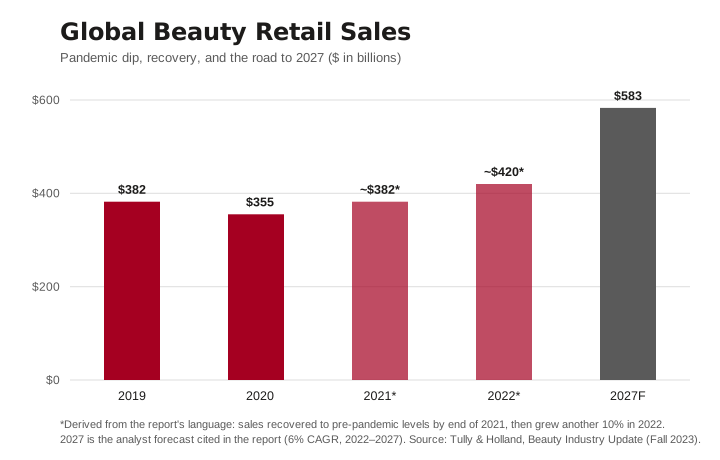
While Beauty has long been viewed as an attractive industry thanks to its ability to deliver strong EBITDA margins of 15% to 25% on average, the recent performance outlined above suggests an even more desirable characteristic – resilience in an inflationary economy. Indeed, in a tough macroeconomic environment, discretionary spending is one of the first categories where consumers look to make budget cuts. However, the Beauty industry’s healthy rebound and impressive growth over the past two years imply that looking and feeling good is more of a “necessity” than many previously thought.
Part of the reason why Beauty products stay top of mind for consumers, even in recessionary environments, is the fast pace of innovation. Beauty is a well-established and considerably competitive industry, where market concentration is low, and elbows are sharp. Within the US alone, there are more than 4,000 Beauty and cosmetics products manufacturers, and the number is growing. The Top 5 players hold a combined market share of 40%, leaving sufficient room for smaller companies to distinguish themselves, grow, and compete.
Owing to relatively moderate barriers to entry, many new companies go into business each year and drive multiple emerging trends that are currently reshaping the marketplace. In line with this observation, market research firm IBISWorld identifies two factors of high disruptive potential for the future of Beauty: (1) innovation concentration (as measured by the mix of patent classes assigned to the industry) and (2) rate of entry (as measured by the annualized growth in the number of companies in the industry).2
Drivers and Themes
What are some of the trends redefining Beauty in 2023 and the brands behind them? Beauty’s hottest trends could be broadly grouped into two categories: product trends and business model trends. Business model trends are observed more widely across industry players, while many product trends are specific to a given sub-category such as skincare or makeup.
Business Model Trends
- Geographic Expansion: While the US and China will continue to be the two most important markets for Beauty, emerging geographies like the Middle East and India are poised to become significant growth drivers for industry revenues over the next five years.
- Omnichannel Sales: Even though the pandemic accelerated the adoption of D2C e-commerce channels, retail and brick-and-mortar presence remain important. Successful Beauty brands employ a diversified sales channel mix to reach as many consumers as possible via their preferred medium. In addition, the customer journey increasingly includes multiple sales channels when, for example, consumers test a product in-store and then go on to buy it online.
- Omnichannel Marketing: Across the board, Beauty companies employ a wide range of marketing channels to reach their target audience, including social media and influencer marketing, traditional advertising, and pop-up store concepts. Increasingly in the industry, the term “influencer” is expanding to include experts, such as doctors and dermatologists, in addition to celebrities.
- Diversity, Equity & Inclusion (DEI): To align with the values of Gen Z, Beauty companies need a comprehensive DEI strategy not only for their hiring practices, but also their products and the communities they build around them. Prime examples here are two of the most successful Beauty brands currently, Rihanna’s Fenty Beauty, which offers an impressively inclusive foundation range of 50 shades, and Selena Gomez’s Rare Beauty, which resonates with Gen-Z based on the singer’s openness to dialogue on mental health topics.
Product Trends
- Convergence with Wellness: The pandemic shifted some of the focus of the Beauty industry towards Wellness, a $1.5 trillion global industry projected to grow at a CAGR of up to 10% through 2027. The importance of mindfulness and self-care is here to stay post-pandemic, and many companies are entering the marketplace to offer wellness-inspired products from supplements to cosmetics inspired by ancient healing systems.
- Notable brands include Rituals, Soma Ayurvedic, Ranavat, Viori, Liquid I.V., and Patchology.
- Premiumization: Premiumization refers to the increased share of more expensive products of higher perceived quality within companies’ product mixes. Taking this one step further, McKinsey & Co. have identified a significant opportunity within the Luxury Beauty space. Enhancing variety through the introduction of novel, high-end products and extravagant, exclusive, or limited-edition concepts could double the $20 billion Luxury and Ultra Luxury Beauty market to $40 billion globally by 2027.
- Examples of brands playing into this trend are OUAI (acquired by P&G in January 2022), Olaplex (backed by Advent International), and Byredo (acquired by Puig in May 2022).
- Personalization: Personalization refers to the capability to offer custom, personalized formulas designed for each client’s individual needs and is mostly seen within the skincare and haircare sub-categories of Beauty. Companies that offer personalized cosmetics usually have a standard questionnaire on their website for customers to fill out. This in turn enables the company to tailor the formula to the customer’s profile.
- Brands at the forefront of this trend include Curology (skincare), PROVEN Skincare (skincare), Function of Beauty (skincare & haircare), Prose (haircare), and Formulate (skincare & haircare).
- Skinification: Skinification refers to applying the principles of multi-step skincare routines to other personal care products, notably haircare.
- Companies driving this trend include Mielle Organics (acquired by P&G in January 2023), K18 Hair, Divi, Nutrafol (acquired by Unilever in June 2022) and Susteau (fmr. OWA Haircare).
- Clean Ingredients & Sustainability: Consumer preference for natural, organic products, free from ingredients with questionable health effects such as sulfates, parabens, and aluminum, is one of the most dominant trends shaping the future of the industry.
- Many major brands have integrated such formulations in their product lines, and new companies entering the space are virtually expected to incorporate a clean label element into their strategy.
Indie Brands: If David Partnered with Goliath
Due to the moderate barriers to entry, much of the innovation within the Beauty industry is driven by emerging “indie” brands. Examples would be brands such as: (1) K18, a science-backed haircare company that plays into the skinification trend; (2) Tower 28 Beauty, an up-and-coming clean label, inclusive makeup brand; and (3) Mad Rabbit, a niche player whose products are specifically crafted for tattooed skin. Owing to innovative product offerings, small but loyal customer base, and a clear path to profitability, many indie brands have enjoyed considerable interest from venture capital investors over the past decade. The true challenge facing these emerging companies is therefore not securing a growth investment, but using that capital to execute an effective growth strategy while preserving product quality and brand image alike.
Research done by McKinsey shows that scaling is a major hurdle Beauty brands need to overcome, even if they enjoy strong momentum in their early days. In one study, out of 46 brands launched after 2005 and with sales between $50 million and $200 million in 2017, only four had surpassed $400 million by the end of 2022. Only one company, the Chinese skincare brand Winona, had generated more than $1 billion in revenues. In another study, out of 78 recently established Beauty brands that each received more than $2 million in venture capital, private equity, or other types of outside investment, 56% have not yet reached the $100 million sales mark as of May 2023. Another 31% of the companies in this study have gone out of business.
While it is by no means a guarantee of success, acquisition by a strategic buyer can be a promising avenue for sustainable growth, provided that both target and acquirer agree on a sound, well-thought-out integration plan. Below we list several examples of recently completed deals that give us a glimpse into how a strategic acquisition can unlock value for both independent brands as the target and Beauty conglomerates as the acquirer:
Unilever’s Acquisitions of Paula’s Choice and Liquid I.V.:
- Unilever acquired the premium skincare brand Paula’s Choice from TA Associates for $2.0 billion in August 2021 to increase its presence in the high-growth Prestige Skincare segment. The company focuses on science-backed formulations, high-performing ingredients, and cruelty-free products. Initially a DTC e-commerce pure play, Paula’s Choice successfully launched into Sephora in 2021.
- Unilever acquired the powdered hydration company Liquid I.V. for an undisclosed amount in September 2020 to augment its Health & Wellness portfolio of brands. Liquid I.V. has been a significant growth center within the portfolio and has seen revenues increase four-fold over the last two years on the back of strong retail partnerships and improved marketing.
L’Oréal’s Acquisitions of Takami and Youth to the People:
- L’Oréal acquired the premium Japanese skincare brand Takami in February 2021 to strengthen the presence of its L’Oréal Luxe segment in North Asia. Developed by board-dermatologist Hiroshi Takami, M.D., the company’s flagship product, the Takami SkinPeel Keratin Treatment Essence, has won multiple product awards and ranks as Japan’s No.1 skincare product. A successful launch in China has helped boost L’Oréal’s second quarter results, offsetting sluggish growth in the United States.
- In another addition to the L’Oréal Luxe portfolio, L’Oréal acquired Youth to the People, a California-based premium skincare brand focusing on vegan, high-performance active ingredients, in December 2021. Since the transaction was completed, the brand has introduced several innovative products, including the Superfood Face Wash, which has been a major success with US consumers.
M&A Landscape and Valuation Overview
We expect to see continued activity in the Beauty M&A space, driven by the industry’s attractive profile and the compelling rationale for strategic acquisitions. While major Beauty conglomerates will likely be the primary growth engine behind much of the M&A activity, the high level of innovation and the dynamic profile of the industry create room for financial buyers to invest early and realize favorable exit opportunities later on. We believe private equity firms like TSG Consumer Partners, Advent International, TA Associates, Alliance Consumer Growth, and Topspin Consumer Partners will continue to invest in Beauty and personal care and will be laser focused on innovation and emerging trends to identify companies that are well-poised to become the next highly sought-after target for strategic acquirers. In an article for Cosmoprof North America, the leading B2B Beauty exhibition in the Americas, Beauty journalist Faye Brookman identifies three key factors driving deal activity in the industry: (1) Beauty conglomerates entering the Clean Beauty market; (2) Beauty conglomerates building their Prestige Beauty portfolio of brands; and (3) indie founders looking to partner with larger companies to achieve scale. All three are elements of corporate strategy, illustrating the prevalence of strategically motivated acquisitions.
Looking at M&A activity statistics over the past four years shows that deal numbers are holding up to the pre-pandemic baseline, but median deal size and average deal value are down. Notably, despite similar activity levels in terms of number of completed transactions, average deal value in 2022 was less than half of what we saw in 2019. This is true even with the inclusion of Estée Lauder’s $2.8 billion acquisition of Tom Ford International, which will allow the New York-based conglomerate to capitalize on the growth of the Tom Ford Beauty brand. (Note: The transaction was technically completed in January 2023 but is included in 2022 in this analysis). The market will likely continue to see fewer megadeals in the coming years, keeping average deal value at the lower end of the historical range. One megadeal recently finalized in 2023 is L’Oréal’s $2.5 billion acquisition of Aesop, from Brazilian personal care group Natura & Co, though such transactions will be rare in a challenging macroeconomic environment defined by hawkish monetary policy in most major markets worldwide. Corporate acquirers will need to be disciplined in their cash spending decisions, which will increase competition for high quality targets.
Valuation Overview
Recent transaction multiples realized in the market are characterized by a wide dispersion: EV/Revenue multiples for transactions completed over the last five years range from 0.4x to 54.9x with a median of 2.2x, while EV/EBITDA multiples range from 5.9x to 269.2x with a median of 51.6x. This dispersion is driven primarily by large deals with outsized multiples paid for companies that bring premium and cutting-edge products to market. The most notable example is designer perfume company Byredo, which was acquired by Puig at an EV/Revenue multiple of 54.9x and a corresponding EV/EBITDA multiple of 269.2x. Transactions under $250 million exhibit more consistency: EV/Revenue multiples range from 0.4x to 3.7x with a median of 1.5x, and EV/EBITDA multiples fall within the 5.9x to 11.6x range with a median of 8.8x. Public market multiples show a relatively moderate, but still meaningful, dispersion. Companies included in the analysis trade at EV/Revenue multiples in the 0.9x to 8.2x range with a median of 2.8x and EV/EBITDA multiples between 6.2x and 43.5x with a median of 15.3x.
Notable Transactions Completed in 2022 and 2023
- Manufacturer of Beauty and fashion accessories based in New York, United States. The company offers Beauty products as well as shoes, bags, clothes, eyewear, and watches.
- The company was acquired by Estée Lauder, a subsidiary of The Estée Lauder Companies (NYS: EL) for $2.8 billion on March 2, 2023.
- The acquisition enables ELC to benefit from owning the fast-growing TOM FORD BEAUTY brand, as well as new licensing revenue streams and other anticipated synergies.
- Manufacturer of skin and hair care products intended to use organic ingredients to foster healthier hair and skin and enable access to a diverse range of clean products at compelling prices.
- The company was acquired by Procter & Gamble (NYS: PG) for $640 million on January 11, 2023.
- Procter & Gamble aims to help the company scale while also assisting future Black-owned businesses with growing, scaling and expanding their companies.
- Manufacturer of luxury skincare products committed to offering cosmetics while spreading awareness on global issues.
- The company was acquired by Beiersdorf (ETR: BEI) for $590 million on February 1, 2022.
- The acquisition complements Beiersdorf's premium skin care offerings and accelerates growth in North American and Asian markets.
- Manufacturer and supplier of Beauty and personal care products based in Toronto, Canada. The company develops private label and control label products such as liquid and bar soaps, body washes, hair care, baby products, specialty bath and nutraceuticals, offering men, women, and children with personal care products.
- The company, a subsidiary of Acasta Enterprises, was acquired by ANJAC Health & Beauty for CAD 327 million on January 7, 2022.
- With this acquisition, the company's established leadership and commitment to strategic, client-centric engagement, as well as to building retail brands for its cherished family of clients will be further enhanced in its association with Anjac.
- Manufacturer of natural and anti-aging skin care products based in Whiting, Vermont. The company offers clean Beauty products such as cleansers, cosmetics, essences, eye treatments and face oils.
- The company was acquired by Amorepacific Group (KRX: 002790) for KRW 168.1 billion (~$128 million) on December 26, 2022.
- The transaction will enable Amorepacific Group (KRX: 002790) to broaden its presence in the North American markets.
- Manufacturer and retailer of perfumes, fragrances and accessories committed to translating memories and emotions into products and experiences.
- The company was acquired by Puig for an estimated EUR 1 billion on May 31, 2022.
- The acquisition reinforces Puig's positioning with a brand that has redefined luxury. Puig will support the continued development of the brand, boosting and nurturing its current positioning.
Conclusion
In such a challenging but equally promising market, acquirers and targets alike stand to benefit from strategic partnerships not only within their industry, but also with key service providers and representatives. We, at Tully & Holland, have spent the last 30 years working almost exclusively with consumer companies, building trusted relationships and deep knowledge of the sector. We would welcome the opportunity to discuss your potential interest in any of our current engagements or explore options for future transactions.
Text reproduced from the report as published by Tully & Holland. Photograph: freestocks.org freestocks, CC0, via Wikimedia Commons.
Keep reading

Vitamins & Supplements Update Fall 2022
Nearly 1,800 U.S. supplement manufacturers compete in a market where the top four players hold less than 15% of revenue....
Read →
Kombucha Industry Update Winter 2024
A fermented tea that started on health-food shelves reached $2.8 billion in U.S. revenue in 2024, growing 19.7% a year s...
Read →
Brewer Industry Update September 2019
By September 2019, more than 7,000 craft brewers were competing for a beer market that had stopped growing. Our update f...
Read →