
Biotech Update Q2 2026
The Money Came Back, and It Is Buying Proof
Biotech capital invested more than doubled quarter over quarter to $133.2 billion, biopharma M&A ran at $55.1 billion in upfront cash, and the IPO window reopened. Our Q2 2026 read on where the capital is going and why clinical stage now decides the price.

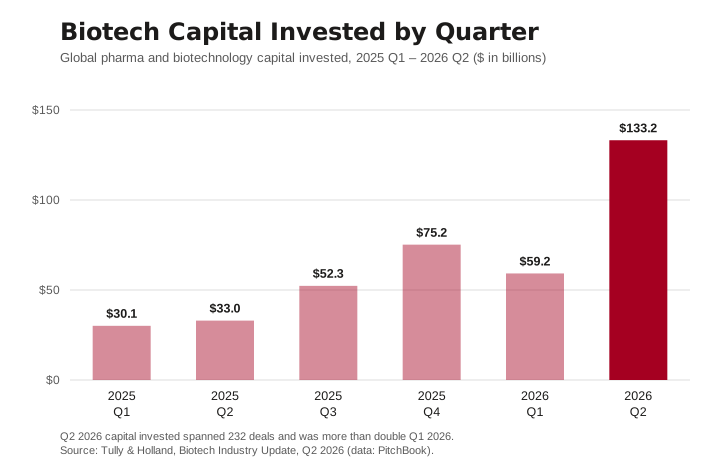
biotech capital invested in Q2 2026 across 232 deals, more than double Q1's $59.2B and above the prior-cycle high of $115.8B set in Q3 2021.
biopharma M&A upfront cash across 48 deals in Q2, the second consecutive quarter above $40B. H1 2026 biopharma M&A reached $96B across 80 deals.
in the first half of 2026 alone, nearly matching the 34 recorded in all of 2025. The clearest sign this is acceleration, not a one-quarter spike.
announced R&D licensing value in H1 2026, more than half of 2025's full-year record. Upfronts were only 6% of deal value: structures stay milestone-heavy.
more biopharma IPO proceeds than any full year since 2022, but 11 of the 13 issuers carried Phase II or later assets. The window is open and narrow.
branded pharma revenue exposed to loss of exclusivity through 2030. That cliff is what is funding the buying.
Executive Summary
The biotech sector continued to emerge from its multi-year downturn in Q2 2026, with the quarter delivering one of the strongest funding and dealmaking environments in recent years. Q2 deal flow was driven by record biopharma M&A, a reopening IPO market, and improving investor confidence in late-stage clinical assets. At the same time, artificial intelligence is reshaping the biotech landscape. AI is becoming increasingly embedded across biotech R&D and development workflows, from target identification and molecule design to clinical strategy and regulatory planning. The technology can materially improve efficiency, reduce development timelines, and enhance the probability of success. With this context, strategic acquirers and private equity investors will remain highly focused on assets that combine scientific differentiation with operational scalability and capital efficiency.
Industry Overview
The global biotech industry continues to represent one of the most innovation-driven segments within healthcare, spanning therapeutics, diagnostics, and enabling technologies. Q2 2026 marked a decisive breakout in biotech deal activity, with capital invested surging to $133.2B across 232 deals, which was more than double the $59.2B recorded in Q1 2026, above every other quarter shown and above the prior-cycle high of $115.8B set in Q3 2021. The rebound was broad-based across subsectors. J.P. Morgan data highlights sustained strength in biopharma, with $55.1B in M&A upfront cash across 48 deals in Q2, which was a second consecutive $40B+ quarter; in H1 biopharma M&A grew to $96B across 80 deals. Announced R&D licensing reached $166.7B in H1 2026, while biopharma venture funding totaled $16.3B across 235 rounds, including $9.2B in Q2. Public markets reopened with biopharma IPOs raising $5.0B across 13 offerings in H1 2026, exceeding every full-year total since 2022.
Financial Landscape
Private Capital Formation
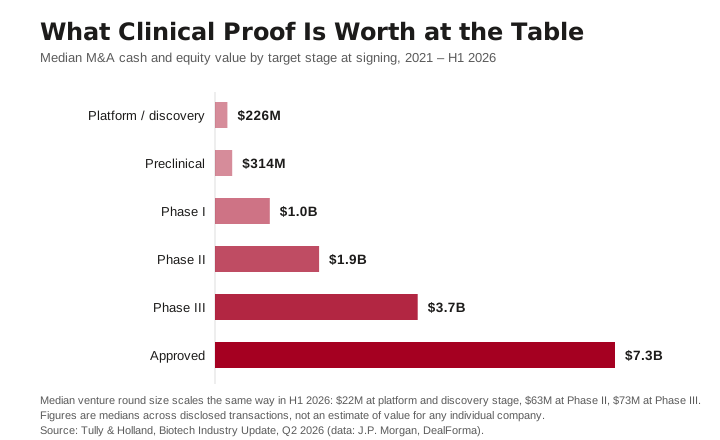
Private capital formation improved though it remains markedly more selective than in the last capital cycle. Capital concentrated in later-stage companies: Series B and later rounds absorbed $11.5B across 121 deals, while seed and Series A companies raised $4.8B across 114 deals. Median funding rounds scaled with clinical maturity, from $22M for platform and discovery-stage companies to $63M for Phase II and $73M for Phase III. Geographically, the United States absorbed 70% of global venture dollars, with the San Francisco Bay Area ($11.3B) and Boston ($8.8B) leading all hubs from 2025 through H1 2026.
A Narrow but Open IPO Window
The public markets have reopened in H1. Biopharma IPOs raised $5.0B across 13 offerings on Nasdaq and the NYSE in H1 2026, already exceeding every full-year total since 2022. The window is open but narrow: 11 of the 13 issuers carried Phase II stage or later assets.
Biotech innovation remains concentrated in key therapeutic areas, including oncology, cardiometabolic and obesity, immunology, and rare disorders. Capital is being deployed at the intersection of unmet clinical need and strong reimbursement dynamics.
The sector reached this point after a difficult multi-year stretch. Public market volatility, high interest rates, and regulatory uncertainty drove a prolonged slowdown in IPO activity and venture funding from 2022 to 2025. But underlying innovation never stopped, and the first-half 2026 data confirms that the capital environment has now become materially more constructive.
While the reopening is significant, H1 2026 proceeds remain well below the 2021 peak, reinforcing that public-market access has improved but has not returned to prior-cycle conditions.
Drivers & Themes
Business Model Trends
AI Integration & Platformization
Biotech companies are transitioning from single-asset development models to platform-based approaches. AI enables companies to pursue multiple programs simultaneously while leveraging shared data and infrastructure.
Shift Toward Clinical Validation
Investors are placing emphasis on clinical data and proof-of-concept validation. Early-stage companies without meaningful data struggle to access capital, while later-stage companies with proven efficacy are commanding strong valuations.
Strategic Partnerships with Pharma
Collaboration between biotech companies and large pharmaceutical organizations continues to expand. Partnerships provide biotech firms with access to capital, development expertise, and commercialization.
Capital Efficiency Focus
In the current environment, companies are prioritizing disciplined capital deployment and operational efficiency. This includes streamlined pipelines, focused R&D strategies, and increased use of partnerships.
Product Trends
AI-Enabled Drug Discovery
AI is significantly accelerating drug discovery timelines, with some estimates suggesting potential reductions from 10–15 years to as little as 3–5 years across the full development lifecycle. AI systems can now screen millions of compounds and optimize clinical trials.
Biological Foundation Models
Next-generation biotech platforms are leveraging datasets to build “biological foundation models” that capture complex interactions within human biology. These models enable more accurate predictions of drug behavior and patient outcomes.
Precision Medicine & Personalization
Advances in diagnostics are enabling more targeted therapies tailored to specific patient populations. This innovation is improving treatment efficacy, minimizing side-effects, and supporting premium pricing models.
Preventive and Data-Driven Healthcare
The integration of diagnostics, monitoring technologies, and AI-driven insights is moving healthcare toward a more proactive model focused on early detection and intervention.
M&A Overview
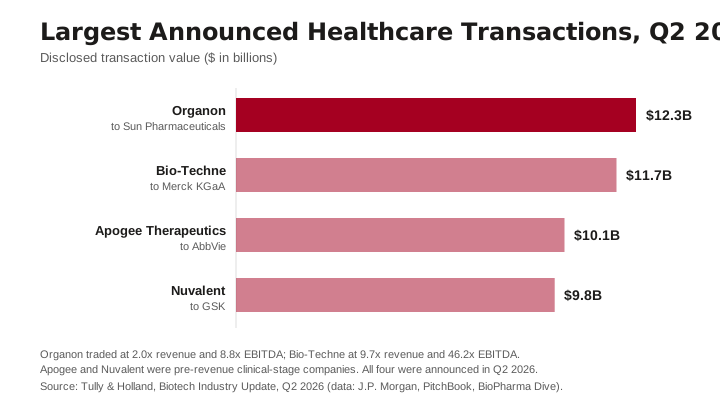
In Q2 2026, AbbVie’s ~$10.1B agreement to acquire Apogee Therapeutics and GSK’s ~$9.8B agreement to acquire Nuvalent headlined a wave of large-cap moves to secure differentiated, late-stage assets across immunology and oncology. Biopharma M&A totaled $55.1B in upfront cash across 48 deals in Q2, surpassing Q1 and marking a second straight quarter above $40B; the first half of 2026 produced 33 transactions valued at $1B or greater, nearly matching the 34 recorded in all of 2025.
The targeted deployment of capital shows a theme of strategic urgency, most notably the need for large pharmaceutical companies to offset upcoming patent expirations and replenish pipelines. As a result, buyers are prioritizing late-stage programs and platform technologies that enable sustained R&D pipeline generation. The 33 transactions at $1B or greater in the first half of 2026 nearly match the 34 recorded across all of 2025, which is the clearest evidence in the data that this is a sustained acceleration rather than a single-quarter fluctuation. That strength is concentrated in strategic activity: corporate M&A value rose 105.9% quarter-over-quarter, while buyout value fell to $33.8B and remains 61.7% below its 2021 peak.
Notable Q2 Announced Transactions
Organon → Sun Pharmaceuticals
Organon is a global pharmaceutical company built around women’s health; it was the largest of the quarter’s healthcare deals at $12.3 billion. The deal reflects buyer preference for immediate, cash-generative scale in a durable therapeutic franchise without the risk of an early-stage platform.
Bio-Techne → Merck KGaA
Bio-Techne supplies reagents, instruments, and diagnostic tools to the life-sciences and clinical research markets, a picks-and-shovels position that sells into pharma and biotech. At $11.7 billion, 9.7x revenue and 46.2x EBITDA, the deal extends consolidation in life-science tools and gives Merck a platform in diagnostics and bioprocessing with one of the quarter’s steepest multiples.
Nuvalent → GSK
Nuvalent is a clinical-stage biotech developing inhibitors in precision oncology, designed to target resistance mutations while limiting toxicity. At $9.8 billion for a pre-revenue company, the transaction echoes the patent-cliff logic, a large drugmaker backfilling future revenue with a late-stage, de-risked oncology asset.
Apogee Therapeutics → AbbVie
Apogee Therapeutics is a clinical-stage biotech developing long-acting biologics for inflammatory and immunology indications, led by programs in atopic dermatitis, asthma and eosinophilic esophagitis. At a 53% premium to the share price, the transaction reinforces AbbVie’s continued effort to broaden its immunology franchise beyond Humira.
Conclusion & Outlook
Q2 represents a genuine reacceleration in biotech capital markets, but not a broad return to 2021 conditions. M&A, licensing, later-stage venture funding, and IPO issuance are all improving, but capital remains concentrated in differentiated and clinically de-risked assets.
High-quality, clinically validated, platform-driven companies continue to attract capital and command premium valuations, while earlier-stage and single-asset companies face increasing valuation pressure. Public markets are strengthening with H1 2026 biopharma IPO proceeds of $5.0B across 13 offerings, including the two largest biopharma IPOs on record (Kailera Therapeutics, $625M; Parabilis Medicines, $670M). We believe the IPO window could widen further for later-stage assets.
Looking ahead, we see several key indicators shaping the trajectory of the market, including the ~$300B+ of branded pharma revenue exposed to patent loss through 2030, sustained large-scale M&A activity, and continued investment in AI-driven drug discovery platforms. For founders and investors, we expect the second half of 2026 to remain constructive. Deal-making should stay both active and selective, with capital concentrated in differentiated, de-risked assets that pair scientific innovation with operational scalability.
At Tully & Holland, we believe the current environment presents meaningful opportunities for both founders and business owners, particularly in segments where innovation, scalability, and recurring value creation intersect.
Text reproduced from the report as published by Tully & Holland. Photograph: Philip Ezze, CC BY-SA 4.0, via Wikimedia Commons.
Keep reading

Consumer Industry Update Q1 2026
Global deal value set an all-time record while capital crowded into a handful of megadeals, and healthcare capital inves...
Read →
Consumer Industry Update Q4 2025
Global M&A closed 2025 at nearly $5 trillion, the strongest year for dealmaking on record, and the fourth quarter set a ...
Read →
Consumer Industry Update Q2 2026
Consumer median deal values set a twelve-quarter record and healthcare multiples touched a twenty-year high, while spons...
Read →