
M&A Deal Process and Timeline
What Actually Happens When You Sell Your Company
Five phases, one disciplined process. A clear-eyed walkthrough of the M&A sale timeline, from preparation to closing, for owners who want to know what they're signing up for before they sign up.

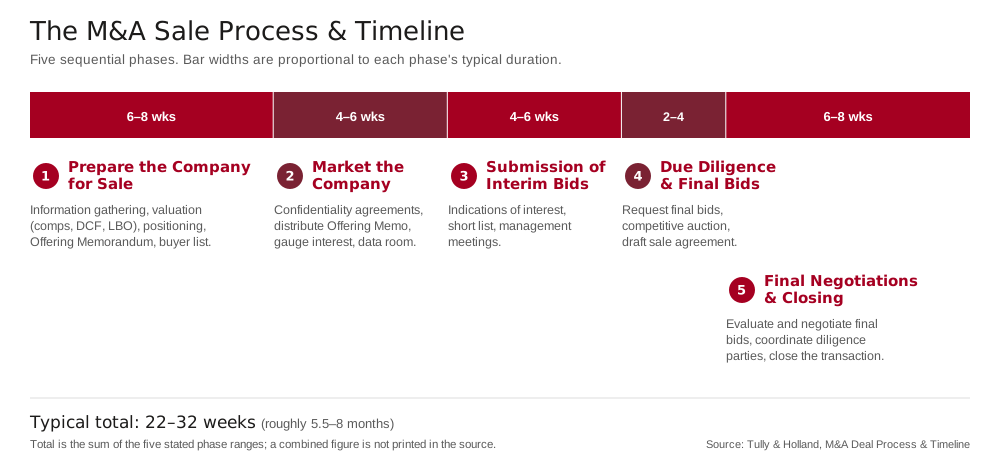
Preparation → Marketing → Interim Bids → Due Diligence & Final Bids → Negotiation & Closing. Every well-run sale moves through all five.
the longest single phase happens before a single buyer is contacted. That's by design.
from kickoff to closing, adding up the stated range for each phase.
competition among parallel bidders, on a level playing field you control, is the mechanism that maximizes value.
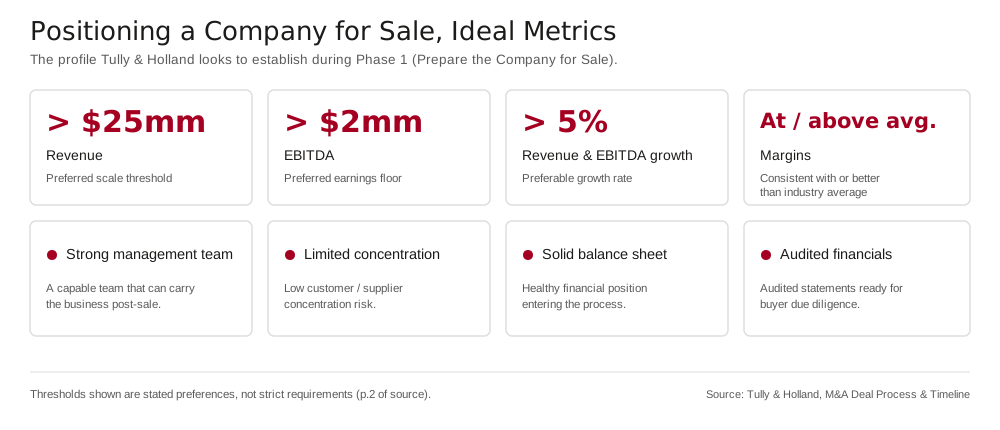
buyers respond best to revenue above $25 million, EBITDA above $2 million, and growth above 5%.
NDAs gate every document. Your employees, customers, and competitors learn about the process when you decide they should.
Key Players
- a. Owners, CEOs, CFOs
- b. Investment Bankers
- c. Accountants
- d. Lawyers
- e. Corporate Development
- f. Consultants
Key Objectives
- a. Maximize Shareholder Value
- i. Determine effective positioning
- ii. Access key decision makers
- iii. Generate competition through controlled auction process
- iv. Design optimal transaction structure
- b. Achieve Strategic Objectives
- c. Maintain Control of Process
- i. Use disciplined approach
- ii. Maintain a level playing field
- iii. Control distribution of information
- iv. Move bidders along parallel paths
- v. Amend process at any time; maintain flexibility
- d. Minimize Management Distractions
- e. Minimize Disruption of Operations
- i. Front-load due diligence/valuation/informal bidding
- ii. Examine merits of pre-emptive offering process
- f. Maintain Corporate Values
- g. Retain and Incentivize Management
- h. Maintain Employees
Phase 1: Prepare the Company for Sale (6 - 8 weeks)
- a. Information Gathering
- i. Review business, financial and marketing plans & documents
- 1. Current and planned business strategies
- 2. Financial and market projections
- 3. Review and analyze capitalization of the company
- ii. Conduct management/employee interviews (on a confidential basis)
- iii. Collaborate and refine potential buyer list
- b. Position Company For Sale – Ideal Metrics
- i. Revenue & EBITDA growth – preferable above 5%
- ii. Revenue above $25 mm
- iii. EBITDA above $2 mm
- iv. Strong management team
- v. Margins consistent or better than industry avg.
- vi. Limited customer/supplier concentration
- vii. Solid balance sheet
- viii. Audited financial statements
- c. Preliminary Price Validation
- i. Market Analysis:
- 1. Compare financial performance of the company with publically-traded companies, compute & analyze implied valuation based on relevant market valuation multiples as derived from precedent transactions
- d. Detailed Price Validation
- i. Income Analysis:
- 1. Review and analyze implied valuation based on historical and projected cash flows of the Company and assumed costs of capital, growth and discount rates
- 2. Sensitivity Analysis to valuation variables
- 3. Base, Weak and Strong economic/business performance test
- ii. LBO Analysis
- e. Preparation of Offering Memorandum
- i. Executive Summary
- ii. Investment Considerations
- iii. Growth Opportunities
- iv. Bidding Procedures
- v. The Company Overview
- vi. Consumer Trends
- vii. Competition
- viii. Financial Information & Analysis
- f. Finalize Buyer List
- i. Strategic fit
- ii. Presumed level of interest
- iii. Financing capabilities
- iv. Likely view of value and potential synergies
- v. Ability to execute a timely transaction
- vi. Confidentiality/competitive issues
Phase 2: Market the Company (4 - 6 Weeks)
- a. Initiate Buyer Contact - Confidentiality Agreements
- i. Distribute Executive Summary
- b. Distribute Investment Overview & Offering Memorandum
- i. Gauge buyer interest
- ii. Arrange due diligence & management meetings
- c. Assemble Data Room Materials
- i. Track buyers
Phase 3: Submission of Interim Bids (4 – 6 weeks)
- a. Receive written or verbal indications of interest, depending on market response
- b. Select “short list”
- c. Schedule management meetings
- i. Buyer and Seller meet face-to-face
- ii. Write Management Presentation
- iii. Coach Management & participating employees
- d. Analyze initial Due Diligence/Information Requests
Phase 4: Due Diligence and Final Bids (2 – 4 weeks)
- a. Distribute letters requesting final bids
- i. Establish competitive bidding/auction process
- b. Distribution of draft sale agreement
- c. Analyze final offers and sale agreements
Phase 5: Final Negotiations and Closing (6 – 8 weeks)
- a. Review and evaluate final bids
- i. Obtain and ascertain formal interest and valuation parameters
- b. Negotiate with final bidders
- i. Maintain competitive bidding/auction process
- c. Coordinate all due diligence parties (accountants, lawyers)
- d. Assist during due diligence process
- e. Assist in closing of transaction
Text reproduced from the report as published by Tully & Holland. Photograph: The White House from Washington, DC, Public domain, via Wikimedia Commons.
Keep reading

Key Performance Metrics for Food Manufacturers
The benchmarks, and the harder-to-measure factors, that move the price a strategic or financial buyer will pay for a foo...
Read →
Food & Beverage Case Study
A shelf stable salad dressing company with $6.8 million in revenue had already been to market once and come back unsold....
Read →
Frozen Food Manufacturer Case Study
A $40 million maker of frozen meatballs and barbequed meats needed capital it could not get from its bank. Two mezzanine...
Read →