
Food & Beverage Case Study
How a Failed Sale Became a Full Price
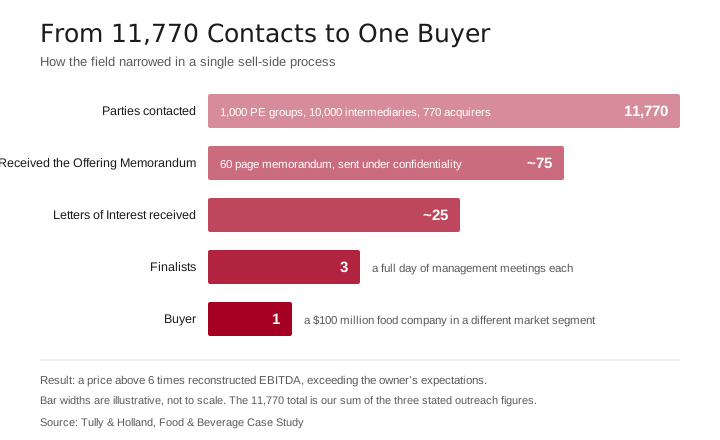
A shelf stable salad dressing company with $6.8 million in revenue had already been to market once and come back unsold. The second process reached 11,770 parties and closed above 6 times reconstructed EBITDA.

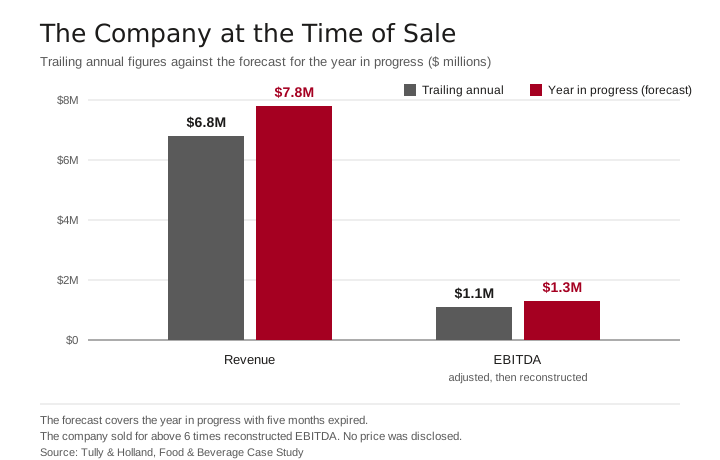
the price the company sold for, and the source states plainly that it exceeded the owner's expectations. The multiple is stated as a floor, not a point estimate, and no dollar price was disclosed.
the trailing annual profile of the business at the time of the mandate. The forecast for the year in progress, with five months expired, was $7.8 million of revenue and $1.3 million of reconstructed EBITDA.
the company had already gone to market with a different investment bank and failed to sell, after the buyer demanded unacceptable price adjustments.
our sum of the three stated outreach figures, 1,000 private equity groups, 10,000 intermediaries, and 770 synergistic acquirers. Most of the synergistic buyers' CEOs were telephoned directly.
roughly 75 potential acquirers received a 60 page Offering Memorandum, roughly 25 responded with Letters of Interest, and three were brought to a full day of management meetings each.
the single largest customer's share of total sales, one of several known flaws the process had to carry rather than cure.
The Assignment
- The mandate was to sell a shelf stable salad dressing company with $6.8 million in annual revenue and $1.1 million in adjusted EBITDA.
- Forecasted annual revenues and reconstructed EBITDA for the year in progress (5 months expired) were $7.8 million and $1.3 million respectively.
The Challenge
- The Company’s sales and adjusted EBITDA were flat or slightly down from 2006.
- The Company had also previously gone to market with a different investment bank, but failed to sell because of unacceptable price adjustments demanded by the buyer. Following the broken auction, the Company sought to remedy its problems by undertaking a complete management change.
- Prior to the management change, a number of problems plagued the Company.
- The original CEO, a talented chef who developed all the recipes, operated from an office in his house and visited the plant only one day a week.
- The product mix was roughly half private label and half branded which was perceived by most acquirers as an undesirable mix
- There was a customer concentration issue with the major customer representing 42% of total sales. The critical “SPINS” data was not available until later in the selling process.
Positioning of the Company
- The Company’s sales and adjusted EBITDA were flat or slightly down from 2006.
- Based on the previous failed efforts of another investment bank, and also from our extensive experience with similar situations, we decided to approach a broad audience of private equity groups (1,000), intermediaries (10,000), and synergistic acquirers (770). With the latter, we telephoned most of the CEOs to make sure they were aware of the selling opportunity.
- Because of the owner’s sensitivity to competitors guessing the Company’s identity, we initially disguised their communications by identifying the client as a “condiment” company.
Scope of Effort
- A substantial number of potential acquirers (roughly 75), including major companies in the condiment business, received a 60 page Offering Memorandum. Letters of Interest (roughly 25) were received and we reduced the field to three of the most attractive offers. Following was a full day of management meetings at the client’s facility with each of the three finalists.
- The intention was to present the client’s management team to discuss the Company’s competitive advantage along with its future growth plans. The objective was to ultimately increase the three offers in a competitive bidding process.
The Result
- The winning offer was from a $100 million food company that operated in a different segment of the market; however, the Company’s new CEO who previously served at a Fortune 500 company, was interested in building a diversified food conglomerate.
- The price was over 6 times reconstructed EBITDA, one that exceeded the owner’s expectations.
Text reproduced from the report as published by Tully & Holland. Photograph: Seth Taylor, CC BY-SA 4.0, via Wikimedia Commons.
Keep reading

Frozen Food Manufacturer Case Study
A $40 million maker of frozen meatballs and barbequed meats needed capital it could not get from its bank. Two mezzanine...
Read →
Catalog Company Case Study
A pre-eminent lifestyle specialty catalog company was selling more than $60 million a year and still losing money. The a...
Read →
Key Performance Metrics for Food Manufacturers
The benchmarks, and the harder-to-measure factors, that move the price a strategic or financial buyer will pay for a foo...
Read →