
Catalog Company Case Study
A $60 Million Business With a $4 Million Problem
A pre-eminent lifestyle specialty catalog company was selling more than $60 million a year and still losing money. The answer was not a sale. It was a recapitalization, found by approaching 70 strategic and financial prospects.

the company was an established name in "independent style" apparel, jewelry, and home furnishings. Scale had not translated into earnings.
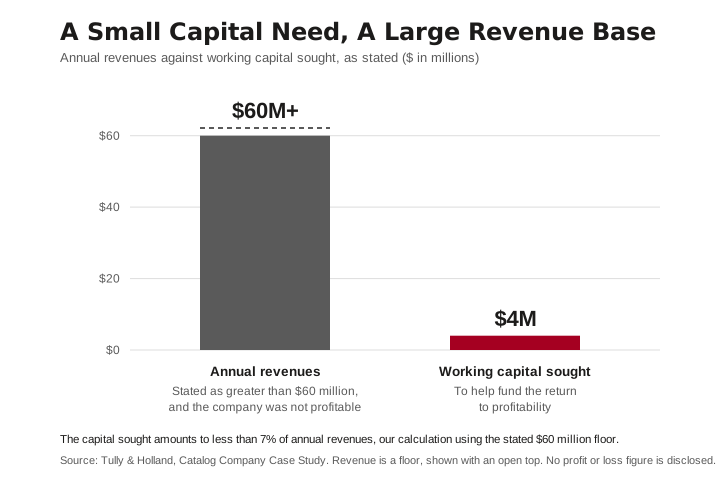
working capital to help fund the return to profitability. Less than 7% of annual revenues (our calculation, using the stated $60 million floor), and still the hardest money in the business to find.
Tully & Holland canvassed 70 strategic and financial parties on the client's behalf. When the story is difficult, breadth is the strategy.
operating acquirers and capital providers underwrite an underperforming business differently, so both universes were worked at the same time.
the engagement closed with a repaired capital structure rather than a sale of the company.
the owners came out of the process carrying less personal financial risk than they carried going into it.
Most case studies are written about companies that were ready. This one was not, which is the reason to read it.
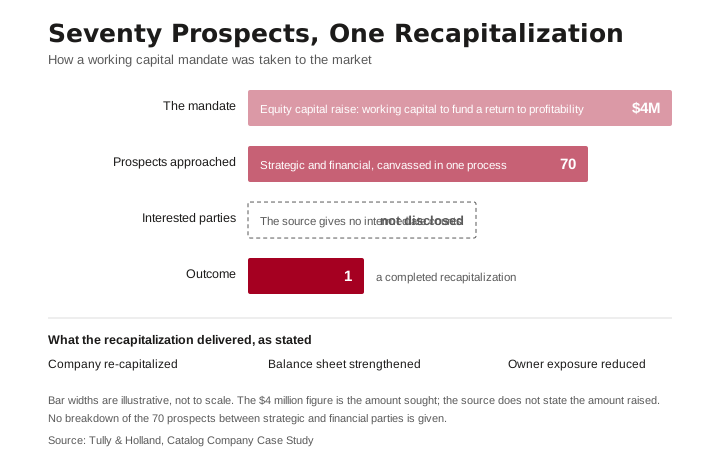
Our client was a pre-eminent lifestyle specialty catalog company, founded by a nationally recognized public figure, selling "independent style" apparel, jewelry, and home furnishings. It had built real scale: annual revenues of more than $60 million, a recognizable identity, and a customer who knew exactly what the brand stood for. It was also not profitable. To fund the return to profitability, it needed to raise $4 million of working capital.
Look at those two numbers together, because the gap between them is the whole lesson. Four million dollars is less than 7% of a $60 million revenue base (that ratio is our calculation, using the stated floor). In a healthy company it is a routine draw on a credit line. In a company losing money it can be the hardest capital in the world to find, because capital does not price your size. It prices your story, and the story at that moment was an unprofitable business asking for cash.
Owners in that position usually see two doors. The first is to put more of their own money in, which concentrates personal risk in the one asset that is already causing the problem. The second is to sell quickly, into the weakest possible negotiating position, and accept whatever a distressed-looking process returns. Both doors take value out of the owner's pocket. There is a third door, which is to change the capital structure rather than the ownership, and it only opens if enough of the right parties are asked.
So we asked 70 of them. Tully & Holland approached 70 strategic and financial prospects on the client's behalf. That number is the point of the case study. When a business is performing cleanly, a tightly targeted process works because the probability of any single conversation succeeding is high. When a business is underperforming, that probability collapses, and the only honest response is to widen the field until the aggregate probability comes back. Seventy conversations also do something a handful cannot: they establish, with evidence rather than assertion, what the market will actually do. A owner who has heard no from sixty parties and yes from a few knows precisely where they stand. An owner who has spoken to three knows nothing.
Running strategic and financial prospects together mattered as well. An operating acquirer looks at an unprofitable catalog business and sees a customer file, a brand, and costs it believes it can take out. A capital provider looks at the same company and sees a balance sheet it can restructure and a recovery it can underwrite. Those are different theses, and neither one is discoverable if you only canvass the universe you already know.
The result, in the client's terms: the company was re-capitalized, the balance sheet was strengthened, and the owners' financial exposure was reduced. Note what that sentence does not say. It does not say the company was sold, and it does not say the owners gave up and walked away. The capital structure was repaired and the people who built the business were still standing behind it, carrying less personal risk than before.
This engagement is from an earlier era of our practice, and the catalog channel has since been rebuilt around digital. The logic has not moved. An underperforming business is not out of options, it is just out of easy ones, and the options that remain are found by a disciplined, broad process rather than by a few phone calls to familiar names.
Photograph: Meanwell Packaging, CC BY 2.0, via Wikimedia Commons.
Keep reading

Frozen Food Manufacturer Case Study
A $40 million maker of frozen meatballs and barbequed meats needed capital it could not get from its bank. Two mezzanine...
Read →
Food & Beverage Case Study
A shelf stable salad dressing company with $6.8 million in revenue had already been to market once and come back unsold....
Read →
Key Performance Metrics for Food Manufacturers
The benchmarks, and the harder-to-measure factors, that move the price a strategic or financial buyer will pay for a foo...
Read →